Themerica

Musings on Thematic Design and the End of Architecture

  • Blog
  • Archive
  • About

Kingdoms of Artifice - Part 1: Oregon Zoo.

November 26, 2024 by Dave Gottwald

This past summer I embarked on site research of a different kind. In 2022 I signed a contract with Dr. Benjamin George at Lexington Books, an academic imprint of Rowman & Littlefield. Our monograph, Disney and the Theming of the Contemporary Zoo: Kingdoms of Artifice, is for their new Studies in Disney and Culture line. Benjamin is an associate professor in the Department of Landscape Architecture and Environmental Planning at Utah State University. We learned earlier this year that Lexington has been acquired by Bloomsbury, a leading publisher of visual arts and design titles. This means Kingdoms of Artifice will reach an even wider and more appropriate audience.

Expedition Everest at Disney’s Animal Kingdom, 2007.

I’ve been collaborating with Benjamin since he contacted me in 2019 over our common interest in theming. This has blossomed into a mutual interest in zoo design and Disney’s impact on that industry in the wake of the opening of Animal Kingdom at Walt Disney World in 1998. From our book proposal:

The opening of Disney’s Animal Kingdom introduced the design principles of the theme park to the display of wildlife. In the decades since, zoo designers the world over have adopted Disney’s approach in theming both the visitor and the animal experience. With Kingdoms of Artifice we critically examine how post-Disney zoo environments combine entertainment with education and complexify authenticity with theatricality.

The village of Harambe at Disney’s Animal Kingdom, 2007.

During a year-long sabbatical and beyond, Benjamin has visited over 30 zoos around the world and interviewed zoo design practitioners and even Disney Imagineers. Thus far, he has amassed over 4,000 pages of transcripts and thousands upon thousands of photos.

One place he couldn’t get to was the Pacific Northwest. In 2023, I received the Paul G. Windley Faculty Excellence and Development Award from the University of Idaho, a $1,000 grant which recognizes three consecutive years of excellence in faculty scholarship and provides support for continuing scholarly activities in written research and dissemination. Funded by this award, in July 2024 I visited the Oregon  Zoo in Portland, Oregon and the Woodland Park Zoo in Seattle, Washington.

Oregon Zoo in Washington Park. Click for link. Map data: Ⓒ Google.

Oregon Zoo

The Oregon Zoo dates all the way back to 1888 and is the oldest in the United States west of the Mississippi. In 1925, the zoo moved to the current site of the Portland Japanese Garden and again in 1959 to its present location within a small valley still in Washington Park. At about 64 acres, the zoo is the most popular attraction in the state.

The zoo’s footprint is an organic shape consisting of multiple elevation levels. The varied terrain adds an element of realism to the various habitat areas and their landscaping. The zoo is small enough to be comfortably manageable in a single-day visit.

Entry Plaza

In the spring of 1998—right as Disney’s Animal Kingdom (DAK) opened—a new entrance plaza debuted at the highest level of the site. The zoo was also connected to Portland’s MAX light rail system via the new underground Washington Park Station later that same year.

This new entrance significantly altered how visitors orient themselves to the zoo and begin their visit. It’s heavily themed to the Pacific Northwest with a series of lodge buildings that recall the nation’s National Parks. There is a large outdoor foyer area between the ticket purchase gate and entrance. To the left is the zoo’s primary gift shop and to the right is a restaurant, restrooms, and lockers.

The cafe’s CASCADE GRILL sign is set in Berthold Block, a typeface family dating back to the early twentieth century and in use at the Disney theme parks for years. The barn lighting, sconces, surface treatments, and painting scheme are all very, very Disney.

Great Northwest: A Unique (and Local) Beginning

Opening along with this new entry area was a completely new way to begin a day at the Oregon Zoo—by starting with the region’s local ecosystems and species. In this way visitors begin with that which is most familiar and then as they navigate and weave their way through the site, everything becomes increasingly exotic. One starts in the grand temperate rain forests of the Pacific Northwest and before you know it, you’re on the plains of Africa.

A Native American presence is introduced immediately, with examples of Northwest Coast art and large totem poles. The landscaping appears to be a blend of Washington Park’s natural vegetation and deliberate plantings.

Immersion exhibits begin as you turn the corner, and they seem to employ a blend of natural and artificial rock work. Only with a trained eye can you spot the difference by looking closely. The safety barriers here are rustic and practical.

Yet directly ahead is what appears to be a mountain highway.

The barrier rails on either side look exactly like those you can find all across the state. The subtle suggestion is that if visitors walked this way, a car might come barreling right towards them.

I thought this was quite clever. With the new 1998 entrance, the circulation path became quite prescribed as one-way. Although I suspect it’s not vigorously enforced (and for photo purposes I definitely trekked the wrong direction more than once, if only for a moment), how do you encourage people to walk the right way, or more to the point, discourage them from heading where you don’t want them to? A themed highway was the answer.

In case the highway barriers weren’t obvious enough, an arrow points to the left. Here the design vernacular of the National Forest system is explicitly replicated with the same shape language, typography, and colors. As I’ve detailed prior, Disney has done this at both their theme parks and hotel resorts.

Following the design of the entry plaza, the entire Great Northwest Trail area is intended to appear to be within a federal or state park. The barriers, decking, and shelter structures literally place visitors in a setting that is familiar to and comfortable for locals. This detailed theming thus reframes the zoo’s entrance as being part of a larger outdoor lifestyle and ties it to the experience of living in the region.

Signage follows the conventions one would expect to find elsewhere in recreation areas throughout Oregon. Although the animals are safely contained within immersion habitats, the verbiage presumes they are all in the wild.

A series of bridges break up the different parts of the trail. The walk down this zone was steep. Climbing back up and winding through the rest of the zoo, however, is gradual. This grading plan is well-considered; the longer your day, the more tired you—and your kids—are likely to get. Completing the one-way loop to return to the entrance is not difficult.

The path descends gradually into a dense forest. The highlights here are the bears, bald eagles, and fish—all staged at unique elevation levels. The hardscape and railings suggest we could be walking through any state park in the country.

And yet, here in the hardscape is something Disney has done for years. There are faux animal tracks imprinted into the concrete.

And also artificial fallen trees. A few of them are used as viewing portals into animal enclosures. This provides a fun and immersive experience for younger visitors. I saw more than one child crawling in to get a closer look. Moments like these turn the zoo into a playground while still feeling natural. Trees do fall in the forest, after all.

To access the eagle habitat, visitors walk through a covered wooden bridge which traverses a canyon stream bed. Of all the zones at the zoo, this first area felt the most immersive because many of the trees were already here; the designers simply and seamlessly integrated bridges, paths, and wildlife viewing areas.

As with using the National Parks vernacular, this is smart. The designers start with what people already know and what they see right outside their city or town everyday in Oregon or Washington. The bridge appears to be very much like what you’d drive through in the countryside, yet scaled down for pedestrians.

Within some of the interior viewing areas, didactic displays are themed to be part of rural sheds. The shape language and material choices harmonize with the covered bridge.

This first Pacific Northwest zone functions much like, in software terms, the onboarding for the Oregon Zoo visitor experience. All the interaction points are introduced—the enclosures, photo spots, touch samples, and reader rails. After proceeding through this first zone everyone can read, essentially, the text of the zoo.

Close to exiting the area, I came across a bear viewing enclosure which highlights their relationship to bees and honey. The shed roof suggests a warehouse of some kind.

There are vintage fruit crate label reproductions—what Disney calls ghost graphics, or subtle pieces of graphic design that contribute to a sense of place. Also stacks of prop honey boxes and barn lighting fixtures which are commonly found in their theme parks.

Family Farm

At the tail end of the Great Northwest section, the landscape flattens out and leads to a farm. Many zoos feature a livestock petting area. Here the theme is classic Midwestern red-and-white, something many American children are intimately familiar with from storybooks.

This is something I had never bothered to look into, but apparently the traditional paint scheme is related to European traditions and also red was simply cheaper. It’s another example of thematic design harnessing a visual grammar that is already known to the public.

The hand washing station looks like a well with themed pipes and spigot-style water faucets.

These are the kinds of antique details a zoo could easily skip, but Disney never does.

Across the path opposite appears to be a back-of-house structure. It is themed, again, to a Midwestern small town, all in white planking. Even though it’s likely just office space, the implication is that the fictional family which owns the farm lives here.

Africa

I’m limiting my visual survey to those areas of the Oregon Zoo where thematic design is most evident. Naturally, there’s an Africa section, which most Western zoos typically incorporate into their layouts. The habitat and exhibit elements here span roughly 1989–2007, augmented over time, and you can tell what’s most recent based on how Disneyized it is.

The entry signage for AFRICA didn’t surprise me at all, but was still disappointing. Since the 1990s designers have substituted Carol Twombly’s Lithos (1989) as a “good enough” substitute for the German wood typeface Neuland (1923), familiar to many as the logo lettering from the film Jurassic Park (1993) and used in tropical, exotic settings ever since. I’ve seen both Lithos and Neuland in wildlife preserves, zoos, aquariums, and water parks. Anywhere there’s a jungle.

Nothing says Africa like thatched huts. It’s not necessarily lazy, but theming needs to communicate cultural motifs at a glance, just like a Hollywood backlot set.

Sometimes they are used for signage and graphics.

Other times you can sit in them.

After thatch, the other common sign of Africa-ness is the shed. These are sometimes used for retail and refreshment locations but more commonly employed for back-of-house structures.

These rustic touches are contrasted with the area’s large aviary.

The exterior is quite modern, and the dark material choices are appropriate for the Pacific Northwest.

You can view the aviary from inside an adjacent restaurant, which I did while eating lunch. The bay window panes provided expansive, unobstructed vistas.

Inside, theming takes over. Fencing and barriers all appear to have been constructed by the local population. Uneven, rough-hewn logs with rope and leather ties.

The designers could have kept the interior as modern as the outside, but chose not to. These small moments provide heightened immersion and serve to place visitors within a different ecosystem with its own human construction language and materials vocabulary.

Just outside, I noticed a large artificial baobab tree sculpted in the Disney style. On some of the upper limbs, real trees have been grafted on and live shrubs are visible. It’s basically a massive concrete planter. These newer additions to the Africa area demonstrate that zoo-ness is increasingly defined by the Disney approach.

Where possible, utility fencing is disguised by natural materials such as bamboo.

Other barriers are more detailed and real wood is used.

These “castaway, deserted island shipwreck” rope ties were imported directly from Disney. You can find them all over the Frontierland and Adventureland areas of their parks around the world, implying everything from pirates to Tom Sawyer. Did fences like this exist at zoos before Disney? I doubt it.

Sometimes they collide with modern safety barriers, here in the case of thick glass.

A few parts of the Africa section were clearly older. You can tell by the lack of overall architectural detail and narrative cues.

When more natural materials such as rough logs and rope ties are used, it’s a sign that theming was added on later.

The older parts of this temple-like enclosure are generically Asian. Here I found Torii Gate-style supports all painted dark brown.

One display in particular reminded me of a Disney dark ride vehicle. In the predator habitat, an actual vintage Landrover safari jeep has been cut in half.

It’s both a photo op and a visitor experience. There are prop crates on the floor for getting into the driver seat, passenger side, and rear of the vehicle.

The jeep has been mounted so that its windshield lines up directly with the glass barrier of the enclosure. The animals water and feed in the shade right outside.

A savannah mural is painted on the three walls behind. It’s a very effective illusion, especially for young children.

You sit behind the steering wheel and if you keep your vision narrow and look straight ahead, it appears that you’ve just driven right into the habitat.

I watched several school groups circulate through. It’s a popular spot.

There is one true ride at the Oregon Zoo. One of the last things I did was board the 5/8 scale, 30-inch narrow gauge Washington Park and Zoo Railway which costs a separate $5 ticket. As it was added when the zoo moved in 1958–59, the Disneyland influence is explicit. The line is a single long loop which features a trestle arc at one end and a curved tunnel at the other just before you return to the station. The railroad used to connect the zoo with another part of the park via a longer route which closed in 2013, and there is currently a movement to restore its original transportation function.

Overall the Oregon Zoo was a pleasant experience, and its design demonstrates the ways in which theming can be used to successfully frame and guide the visitor experience.

A new Draft Campus Plan for the site was unveiled in January 2024. Developed in partnership with CLR Design, a leading exhibit and habitat architectural firm based in Philadelphia, on the plan it remains to be seen what new thematic elements—if any—will be added. I certainly look forward to seeing what their designers come up with.

Continued in Part 2.

November 26, 2024 /Dave Gottwald

Animate(d) Architecture Now Available in eBook and Hardcover from Liverpool University Press.

May 10, 2024 by Dave Gottwald

If you don’t write for an academic audience, it can be hard to grasp just how long it takes to bring a project to market. I’m delighted to announce that Animate(d) Architecture: A Spatial Investigation of the Moving Image, a collection edited by Vahid Vahdat and published by Liverpool University Press, is now available in eBook and Hardcover. From the press blurb:

The volume examines animation from a spatial lens. It offers interdisciplinary outlooks to the role of space in animation, including in creating humorous moments in early cartoon shorts, generating action and suspense in Japanese anime, and even stimulating erotic pleasure in pornographic Hentai. Animation, in this book, is approached as a medium that can equip the designers of the built environment with a utopian scope to address our socio-political and ecological crises.

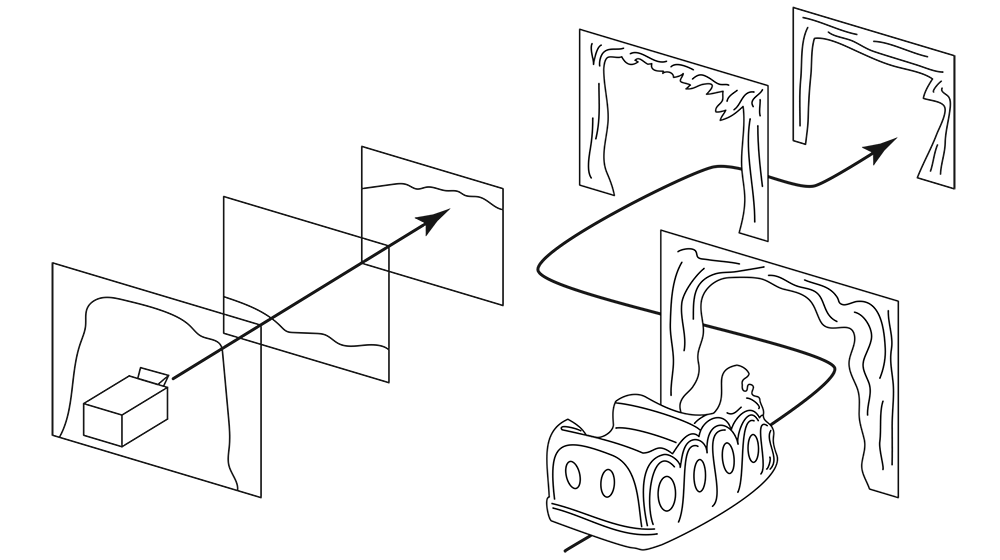
Comparison of the visual grammar of the multiplane camera and the Disneyland dark ride.

In my chapter, I describe how Disney’s dark ride model represents a kind of spatialized animation, and I further suggest it is a forgotten conceptual link between animation, the theme park, and today’s first-person gamified and virtual worlds.

I’m especially honored to be published alongside a scholar I have long-cited in my own writing, J. P. Telotte. And as with my prior publications, I enjoy executing my own illustrations. More information about the other contributors and their essays can be found at Liverpool University Press.

May 10, 2024 /Dave Gottwald

The Typography of New Orleans Square.

November 29, 2023 by Dave Gottwald

As seen prior, during the summer of 2021 and 2022 I was able to visit the Disneyland Resort and continue my site documentation photography. Following my last post on the Typography of Galaxy’s Edge (the park’s “Star Wars Land”), I’d like to take a small break from my manuscript work to share some nice examples of the lettering to be found in my favorite area of Disneyland Park—New Orleans Square.

New Orleans Square (NOS) was the last expansion of Disneyland that Walt Disney was personally a part of. The first new full “land” to be added to the park, it opened on July 24, 1966—well in advance of its signature attraction Pirates of the Caribbean and accompanying table service restaurant, The Blue Bayou—with a dedication ceremony featuring then Mayor of New Orleans, Victor H. Schiro. Costing some $18 million, a million more than all of Disneyland in 1955, Walt Disney reportedly quipped to the press that his new land, a tribute to The Big Easy of the Antebellum South, was pricier than the Louisiana Purchase itself.

I hadn’t noticed the above wordmark in NOS until recently, which is carved into a stone surface on a pillar outside The Haunted Mansion. The lettering and application certainly does not date from 1966. If I recall correctly, I first remember seeing this mark in the 1990s, and it has been used on merchandise ever since. The style is appropriate for the land, with elaborate swashes and some characters like the “A” which resemble a modified ITC Benguiat. Overall, however, it does feel a bit too “logo-ish” as if it was designed to be printed on a sweatshirt for a sports team.

The signage which dates to the opening of the land in 1966 is really something special, like this above example from table service restaurant Cafe Orleans. From the late 1960s into the mid-1970s, design was going through many period revivals, one of which was Art Nouveau. So although NOS was meant to represent the city of New Orleans before the Civil War, the graphics and lettering to be found throughout the land aren’t accurate to that period at all, but rather reflect popular art and design trends during its development and construction.

Since France was a center of the turn-of-the-century Art Nouveau movement, the Imagineers must have thought, okay, French, New Orleans, makes sense. Hand-painted floral illustrations and stylized serif lettering demonstrate this sensibility throughout, like on the wall outside the Mint Julep Bar.

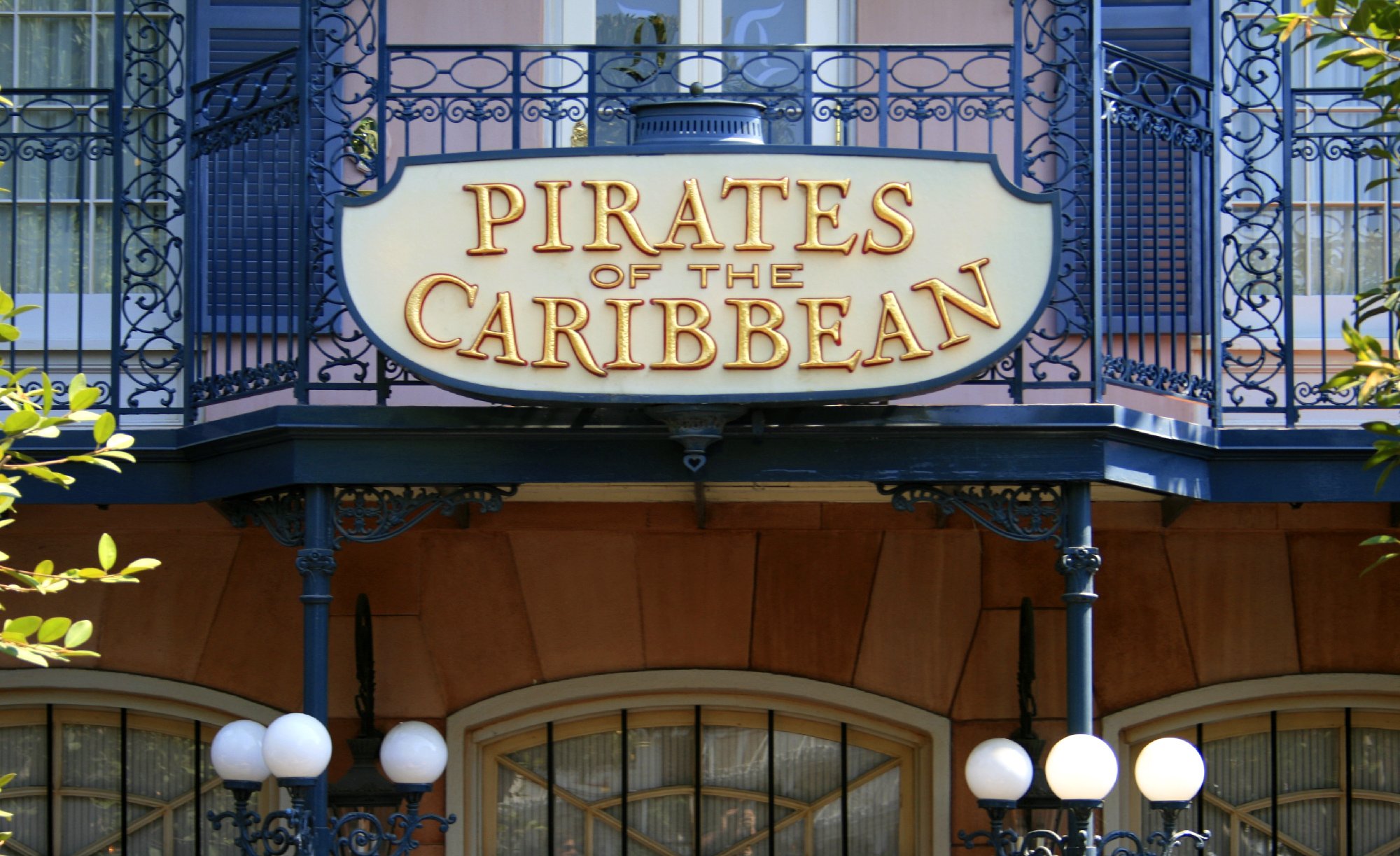
The late 1960s was the height of the phototypesetting era, and this poster-size sign which has sat at the entrance to Pirates of the Caribbean since it opened on March 18, 1967, provides a solid bouquet of the kinds of offerings that were popular in phototype catalogs.

Along with Art Nouveau, typefaces from the Victorian era were being revived at this time. “Sail With The Tide” is set here in Art Gothic, originally designed in the 1880s but brought back for phototype and later for digital. You might recognize it as the title face for the television series Murder She Wrote or from the album cover for Siamese Dream by The Smashing Pumpkins.

Some of the finest signage at Disneyland is routed in wood, and this “Exit Through the Gift Shop” notice at Pirates is no exception.

The serif treatment of the attraction name here matches other nearby applications, but I suspect the sign dates from the 1970s or even the 1980s with the line treatment of the skull and crossbones.

Some signage is more playful than historical, as at that same gift shop just off the exit to Pirates, Pieces of Eight. Throughout NOS there is serif and swash work that to my eye anticipates some of the major trends in typography which would emerge in the 1970s, like the elegant forms of Ed Benguiat’s ITC Bookman and its swash variants, which are still popular today.

Look closely and you’ll notice that the illustration in this hanging oval sign above the other entrance to the shop is replicated small on the first one.

Much of the safety information in the park dates to the 1990s, but the designers have usually done a good job of making substrate and printing choices that align with the overall theme. This is a contemporary, digital italic serif, yet it fits with period samples like The Fell Types which are used to evoke the swashbuckling era.

The graphic designers at Walt Disney Imagineering don’t always get it right, however. This sign probably dates to the late 1980s or early 1990s. And while the main Roman characters and corner ornaments feel right for NOS, the “Please” in Brush Script definitely does not!

Hand painted Roman type abounds in NOS. This choice reminds me of the lettering used in The New Yorker, especially the leg of the “R.” It’s a style that was common in the 1910s and 1920s, so it makes sense that this was probably referenced from a phototype revival font.

Sadly, this lettering is cut vinyl, and the sharp serifs don’t really fit with other signs throughout the land. Yet the silhouette of the man with the top hat? There’s The New Yorker again. Odd.

Poking around, I found a few examples I’d never noticed before, even after visiting Disneyland for decades and pouring over the park in detail in search of hidden gems. And here is such a sign. The script employed here is serviceable—very much in the vein of Matthew Carter’s Shelley family, which would not arrive until 1972—and appears hand painted based on a character set.

I’m not going to lie; the tail on the “y” bothers me. Too extreme.

For years the French Market quick service restaurant had featured elegant swash type on its signage and menu boards, but it has recently been rebranded as Tiana’s Palace and themed to The Princess and the Frog (2009).

I’ve always admired the lead entry sign to the Blue Bayou Restaurant, which is hand painted on glass and also appears to be from a phototype sample.

Like so many signs at Disneyland, it looks wonderful at night and takes on a different personality after dark.

Since 1967, The Blue Bayou has featured a very elegant and stately double-B monogram of the Shelley variety on their menus, but this particular application is relatively recent, within the last ten or fifteen years.

In the same location near the host stand, you can find this newer script, and I think it’s a poor choice. It looks more at home on a Prince album cover from the 1980s than at the classiest table service general admission eatery in the park.

Purple Rain Bayou?

Behold the original entrance plaque to the mysterious Club 33. I have always absolutely adored this double-3 mark. The numeral forms are quite unique, they harmonize with the double-B monogram directly next door at The Blue Bayou, and they inject a bit of mid-20th century modernism into an otherwise 19th century setting.

Very 1960s executive class, very Mad Men.

I’m far less enamored with the revised 2014 mark, in which the designers decided to lean in on the Art Nouveau sensibilities that have been present in NOS from the very beginning. Solid reasoning, to be sure, but there is something about that 1960s advertising suite ‘33’ that can’t be topped. Also, if you tip it sideways, the original mark can read as MM for “Mickey Mouse.” Not so with the new one.

Still, the remodeled club, which I visited in July of 2021, is exquisite and tasteful. The revised mark looks absolutely stunning in mosaic tile at its entrance.

One of the most famous attraction marks in all of Disneyland’s history is probably the lettering for The Haunted Mansion. This plaque sits at its entrance, and has roots in a Victorian woodcut typeface called Rubens which was a popular phototype revival during the 1960s. Designed by John F. Cumming in the 1880s, every major foundry of the era featured a cut of it in several weights.

You might recall it being used in the opening titles for the 1980s series Knight Rider. Digital versions informed by its Disney application are available from many sources, the best of which is David Occhino’s Mansion.

More recent entry and safety signage from the late 1990s and early 2000s employs Runic, a Monotype face that dates back to 1935. The Imagineers made a good call here; to my eye Runic vibes well with Rubens.

Victorian serifs of a similar character as Rubens can be found scattered throughout NOS. This painted lettering appears to be based on a phototype revival of a face from the 1880s called Jefferson. Similar serifs from the same era include Washington, Webster, and Lafayette. Lettering like this has been used by Sierra Nevada Brewing and the band Alkaline Trio.

Here’s another choice that appears to harmonize well with Rubens. Look at the “M” in particular. As far as I can tell, this shop dates back to 1966. The Haunted Mansion didn’t open until 1969, but had been in development since the early 1960s. This makes me think that the graphic designers at Imagineering might have been working on typography for the land for quite a while, and made many of the same phototype selections within the same time frame. Wonderful custom swashes; this might be my favorite sign in the entire land.

The lettering is also repeated in a painted graphic on a nearby wall. According to Yesterland, the lower text “Sacs & Modes” refers to a flower shop that existed in NOS from the mid-1970s to the mid-1980s.

Some of the newer pieces in NOS are as detailed and lovely as the original 1966 material. This plaque was added above the small fountain in the entrance courtyard of Pirates for the attraction’s 30th anniversary in 1997. Disneyland’s medieval wordmark is faithfully reproduced, and the stylized swash treatment of the attraction name is just out of this world.

Again, the graphic designers at Imagineering don’t always nail it, though. This entrance sign dates to the late 1990s or early 2000s, and just strikes me as cheap looking. Like something you’d see at a Six Flags park. The Roman lettering is straight out of Adobe Illustrator, with amateurish dotted strokes set outside the rounded characters. “Of the” looks to be set in Apple Chancery, or something equally low rent. And the ornamented cross at the bottom is almost falling off the sign. It’s gross.

Some of tackiest stuff in NOS dates to the early 2000s and is tied to the branding for the Pirates of the Caribbean film series, which features some terrible typography in its posters and marketing materials.

But Imagineering appears to have recovered from that sad era. Some of the latest additions, like this sign for the 21 Royal dining experience, appear as if they’ve been here since Walt Disney first opened the land back in 1966.

The monikers for Club 33 and 21 Royal aren’t unique. In fact, nearly every retail and dining space in NOS has a numbered street address. You can find them painted in a variety of lettering styles throughout.

The carved piece near the entrance to 21 Royal might pre-date the dining experience, but I can’t be sure. It certainly feels 1966.

I was fortunate enough to dine at 21 Royal in June of 2022. Though I took plenty of pictures, the space was devoid of typography for the most part. I did spot the iconic Disneyland “D” on the tile work in one of the bathrooms.

The famous “D” is derived from the original Disneyland wordmark, a piece of lettering that has been constantly evolving since 1955. I’m wondering if the tile application in 21 Royal is a nod to its prior use in the signage for the VIP Dream Suite. Originally, this space above Pirates was intended to be a private apartment for Walt and Roy Disney, then it was used as the Disney Gallery before being converted into a VIP overnight experience and finally a exclusive dining one.

You see one version or another of this D all over the park. They vary somewhat based on the year. This one is on a popcorn vending cart just outside The Haunted Mansion.

Speaking of popcorn carts, there is some nifty recent lettering on the NOS ones. Like I’ve discussed prior, the graphic designers at Imagineering have been very big on using the antique stylings of the Letterhead Fonts foundry for the past fifteen years or so. That appears to be what we have here. This looks very close to Prince. Of course any designer worth their paycheck is going to try and customize a typeface when they can, and this may have happened here.

Here on the side of the cart we have more Letterhead loveliness. The “AND” appears to be Boston Truckstyle, which the Imagineers have used extensively over at California Adventure as well.

I’ll finish here with perhaps my favorite typographic classification, the slab serif. New Orleans Square has always shared a Disneyland Railroad station with the adjacent Frontierland since its opening, so in deference to that elder, opening day land, the lettering on its queue structure is appropriately Old West.

On the side of the roof is a different woodtype slab, a look called “French Clarendon” or sometimes “Playbill” due to its use on posters and playbills of the late 1800s and early 1900s. It also recalls the “WANTED” posters common to Wild West movies and TV shows.

One of the pleasures of walking around Disneyland as a graphic designer is taking in all the signage, much of which is—still, to this day—hand painted or hand applied. These typographic delights, usually quite well-attuned to a given time and place by the Imagineers, are but one small part of the gestalt of visual details which make themed spaces so immersive and engaging.

November 29, 2023 /Dave Gottwald

The Typography and Graphics of Galaxy's Edge.

May 14, 2023 by Dave Gottwald

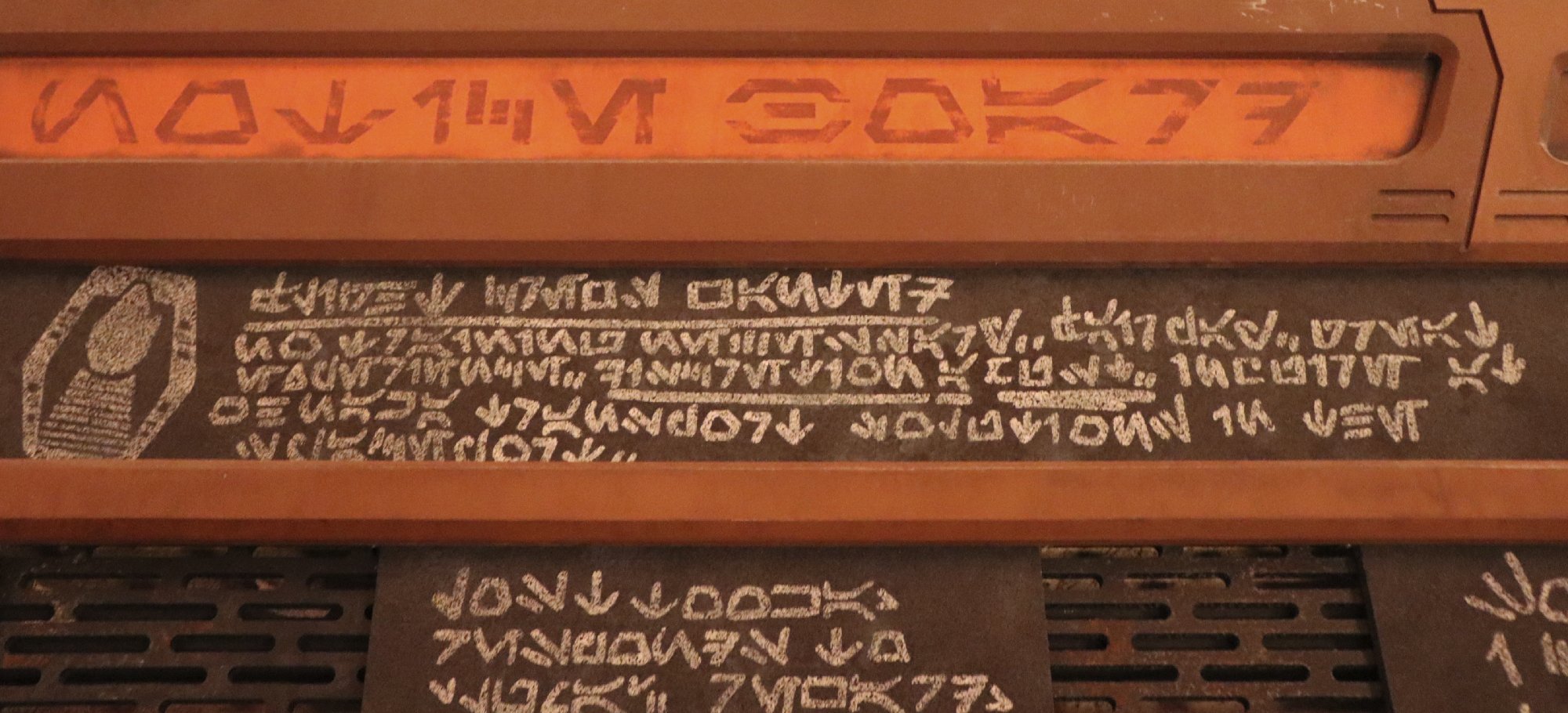
Typography—that is to say, the use of lettering on signage and props—is an essential part of world building within themed spaces. From the first moment I set foot in the Star Wars: Galaxy’s Edge expansion at Disneyland, I was astounded at the level of detail the designers put into their deployment of the “Aurebesh” alphabet.

This constructed script was first used on screen displays in Return of the Jedi (1983) as designed by Joe Johnston, an art director on the film. He called the original character set he developed Star Wars 76, and it has been modified several times since for use within the Star Wars universe of films, television series, and merchandise.

Aurebesh is not the only alien language in the Star Wars universe, however. This entrance sign is masterfully rendered in one of these other alphabets.

Equally impressive is the ways in which English is incorporated throughout the land. Graphically, all the signage is “of a set” and completes the immersion begun by the space planning, architecture, and landscaping of Galaxy’s Edge.

Sometimes the use of English is charmingly and deceptively non-obvious, as at the entrance to Oga's Cantina. Many guests might walk right past and not read it because at a glance the lettering could be an alien language. Look closely, however, and the Roman characters emerge.

This “pass-by” read is reinforced by other nearly identical graphic treatments to the entrance of other interior spaces which use Aurebesh, like here at Savi's Workshop.

The verisimilitude of Galaxy’s Edge is tightly bound up with the unintelligibility of these signs. Just like wandering around any city on Earth where you don’t speak the language, guests visiting Black Spire Outpost on the planet Batuu feel as if they are encountering a truly alien place.

What does this say? If you want to know, the designers have added an extra layer of interactivity to Galaxy’s Edge. By installing the Star Wars: Datapad on Play Disney Parks Mobile App, there is actually a feature to translate the Aurebesh alphabet into English. Simply point your smartphone at the signage.

The variety of applications throughout the land is very cool, and all are appropriately distressed. Just like other aspects of the Star Wars universe, this is a “used future” in which nothing is shiny and new.

Operational Graphics

The Disney Imagineers have different level of graphics which they apply in their placemaking. The first, and more important, are Operational Graphics. These need to be in the native language of the guests, and, though stylized, fairly legible.

A large subset of these are wayfinding, just like the directional signage you would find at a mall or a large airport. In many examples throughout Galaxy’s Edge, the Aurebesh lettering is featured as a secondary language. Here the subtitles for each location are not required, and the titles can be clearly read in English.

The stylization of operational graphics is a delicate business. Here the wait time indicator at Millennium Falcon: Smugglers Run needs to be loud and clear for guests. Notice that the lettering is subtly bolder with less flourishes than the earlier example.

Like any other visual hierarchy, scale undoubtedly helps. This exit sign for the attraction is quite stylized, but painted very large on the wall.

Just like in the real world, repetition also helps with recognition. EXIT is rendered the same way everywhere in Galaxy’s Edge, so if you’ve read it once you won’t give it a second thought the next time.

A common challenge with operational graphics is when they intersect with regulatory requirements. This restroom meets the international standard for the MEN icon while still feeling part of the world of Star Wars.

Similarly, this working fire hydrant needs the appropriate labeling but is stylized to the rest of the operational English as seen throughout the land.

As are the health warnings as required by California law.

Perfect theming is not always possible, of course. Although the STAFF ONLY lettering here is stylized, the State of California Alcoholic Beverage License must be displayed as is.

Yet the designers will modify Disney’s own internal language for operational graphics if it’s appropriate. Here the standard Cast Members Only is restated as AUTHORIZED PERSONNEL ONLY to make it more officious.

Story Graphics

The second category are Story Graphics. Like the name of the entrance to a shop or eatery, these bits of signage reinforce the reality of the narrative being established by the space. Here is a parking sign like you would find in an actual urban environment.

Successful story graphics express vernacular, or the recognizable and credible look of existing solutions and systems. This flight space announcement appears just as it would at a bus depot, subway station, or airport terminal.

Sometimes story graphics connect “our” world of products and services with the fantasy of a themed environment. The Coca-Cola brand is rendered in an alien script with just enough signifiers to tell us that it’s a “real” sign where we can purchase a Coke beverage. Is there Coke in Star Wars? Nope. But it doesn’t matter, because the story graphic has successfully inserted the brand into the environment, and thus, the world.

Ghost Graphics

The final category are Ghost Graphics. These bits of lettering, signage, and displays don’t so much as offer narrative as to complete the picture of the environment. This single line of Aurebesh doesn’t tell us anything other than to complete the reality of the computer wall panel.

Ghost graphics are also applied to objects. This appears to be a piece of luggage of some kind, but we don’t get any other information about it. This is the definition of ghost—these graphics float around almost invisible in the background, but add reality nonetheless.

Sometimes ghost graphics can subtly support story objectives. This pair of storage tanks is a ideal example. “Fr” is clearly a brand mark for a company of some kind, perhaps a petrochemical concern.

Imagineers often use ghost graphics to establish the history of a space; to give it the sense that there have been many different layers of inhabitation over the years. Here some kind of signage has faded away in the hot sun, and new lettering has been written on top in a kind of graffiti.

And of course all three types of graphics may contain iconography. Here the operational graphic on an automatic door incorporates an icon that feels “real world” in its utility.

On this story graphic, however, the meaning of the symbol is unknown to us; it serves no function. It means GROUND CREW only to the characters within this storyspace, yet it belongs in the same icon system as the sliding door.

Lastly, the designers will sometimes add an Easter Egg or “inside joke” into the graphic landscape. For example, within the Millennium Falcon set there is an XO on the wall which only serves as a reference to where Han Solo and Princess Leia shared a brief kiss.

Whether operational, story, or ghost, all the graphic design and typography within a themed environment contributes to the immersion and inhabitation we experience.

Disney has a short video from their Imagineering in a Box series that covers many other examples from their parks if you are interested in learning more.

May 14, 2023 /Dave Gottwald

Virtual Interiorities Now Available in eBook and Softcover from Carnegie Mellon ETC Press.

January 17, 2023 by Dave Gottwald

It’s certainly been a while since I’ve posted here. And with good reason! I’ve been quietly shepherding a book project to completion over the past nine months along with my co-editors Gregory Turner-Rahman (my colleague at University of Idaho) and Vahid Vahdat (Washington State University).

This three-volume collection of essays from Carnegie Mellon University ETC Press examines the virtual beyond the headset. Here you will find multiple, sometimes unexpected entry points to virtuality—theme parks, video games, gyms, pilgrimage sites, art installations, screens, drones, film, and even national identity.

Each volume is available separately as PDF, ePUB, and print-on-demand:

Book One: When Worlds Collide

Book Two: The Myth of Total Virtuality

Book Three: Senses of Place and Space

The project began in the summer of 2020 and at long last went was released on December 15, 2022. We’re super proud of this collection which links ongoing discussions in the humanities, film, game studies, architecture, and design disciplines under the aegis of what “virtual” means in a socio-spatial context. As our press blurb states:

Contemporary virtual reality is often discussed in terms of popular consumer hardware. Yet the virtual we increasingly experience comes in many forms and is often more complex than wearable signifiers. This three-volume collection of essays examines the virtual beyond the headset. Virtual Interiorities offers multiple, sometimes unexpected entry points to virtuality—theme parks, video games, gyms, pilgrimage sites, theater, art installations, screens, drones, film, and even national identity. What all these virtual interiorities share are compelling cultural perspectives on distinct moments of environmental collision and collusion, liminality, and shifting modes of inhabitation, which challenge more conventional architectural conceptions of space.

A Journey from Total Cinema to Total World

My own chapter in Virtual Interiorities appears in Book Three and is an expanded version of an article I published this past year in the latest issue of Disegno—The Journal of Design Culture. That article was chosen as the lead piece for the issue's theme Total Cinema: Film and Design which seeks to interrogate French film theorist André Bazin in new ways. Disegno—The Journal of Design Culture is published by the Moholy-Nagy University of Art and Design in Budapest, Hungary.

In addition to writing and co-editing, I designed the book covers with Greg. He provided the imagery and I supplied the typography and layout.

Example page layout in CSS 4, rendered for ePUB and PDF in Prince.

One particular challenge which was very rewarding was having control over the internal typography and layout of the book. ETC uses the Pressbooks platform for electronic and print-on-demand formatting. There are some basic templates to choose from which are styled using CSS 4 and rendered by an HTML to PDF engine called Prince. By extensively modifying that code, I was able to customize every class of type in the book, and even control positioning on the page throughout the layout.

Table of Contents in CSS 4.

This was extremely useful for front and tail matter which required extensive visual hierarchy. I had never used CSS to such detailed extent before, and certainly never in page layout for print. It was a lot of fun.

Since this is very much an image blog, also here are the illustrations I created to accompany the article and subsequent chapter.

Teatro Olimpico di Vicenza.

Bazin used the Olympic Theater of Vincenza as his example of how the architecture of the stage functions as an internal world to keep it isolated from reality outside.

Disneyland’s collapsed, common stage.

Within the themed environment Bazin’s spatial construct of the theater folds in on itself. Tourists are called “guests” by Disney because we have been invited by the cast onto a collapsed, common stage.

Typical game engine design space.

The game engine is explicitly cinematic: the operational metaphor is a virtual “camera.” Bazin’s mask is here called the view frustum, which represents the camera’s field of vision—the region of the virtual world which will appear on screen.

StageCraft Volume set.

StageCraft is the combination of a Volume set covered in LED panels with live Unreal game engine content. The LED surfaces not only display content, they also provide realistic lighting with adjustable color.

From Bazin’s segregation to unified experiential medium.

Bazin’s inexorable segregation of film and stage was two-fold with his fixation on the spatial characteristics of each and then on how those aspects formulate and facilitate the relationship between audience and performer. What Bazin could not foresee was how media would shift from passive to active, and how theater and cinema would become a new, single medium of participatory interaction.

So pleased and proud that Virtual Interiorities is now a reality! More information about the contributors and their essays can be found at the project’s website.

January 17, 2023 /Dave Gottwald
  • Newer
  • Older

All original content on this site © 2007—2026 Dave Gottwald.
My photography is licensed under Creative Commons NonCommercial 4.0.
You are free to use my images for non-commercial purposes only.