Themerica

Musings on Thematic Design and the End of Architecture

  • Blog
  • Archive
  • About

Polynesian Pop Vegas - Part 6: The Tiki Bar (at Excalibur).

August 29, 2026 by Dave Gottwald

I was chatting with my pal “Tiki Teacom” recently, the fella who had recommended Stray Pirate for my Vegas visit. And he said something really interesting. Teacom mused that just as the mid-century Polynesian Pop movement had a rise, a peak, and a decline, perhaps the pattern was now repeating.

After the revival of the early 2000s and 2010s, were we approaching a decline again?

It seems to me that dozens of tiki bars are popping up everywhere, and worse, non tiki bars [are] trying to add tiki. I feel like we're at the leading edge of the fern bar era.

By “fern bar era,” Teacom means the period during the late 1970s and early 1980s when exotic cocktails were on the way out, wine coolers were in, and obnoxious single bar chains started to pop up nationwide like TGI Fridays and Bennigan's. It was a cultural nadir for mixologists everywhere.

Case in point. This December 2025 addition to the medieval-themed Excalibur Hotel and Casino (1990), simply called The Tiki Bar.

There are some considered nods to mid-century Polynesian Pop design. The bamboo A-frame entrance portal, for example, is a well-established trope.

Yet you can see the remains of Excalibur’s original architectural flourishes, even if they’ve been painted dark brown in order to recede from view. There is a stylized version of a castle drum tower which has now been wrapped with tropical rattan pattern wallpaper. And the trim of a parapet wall above with its raised portions (merlons) and gaps (crenels or embrasures).

Playing on the “trader” theme as personified by Vic and others, there are stacks of bare wood crates with stenciling on them. This is a port of call. The crates do a good job of forming an exterior wall between the entrance and the bar area.

I was actually impressed with the bamboo work, but I was unable to track down who provided it. While basic, the planking here easily separates the interior carpeting from the casino floor pattern. The nautical rope is thick and authentic.

Another mid-century trope in the form of this hanging light fixture at the apex of the bamboo A-frame. This easily could have been at home at Golden Tiki.

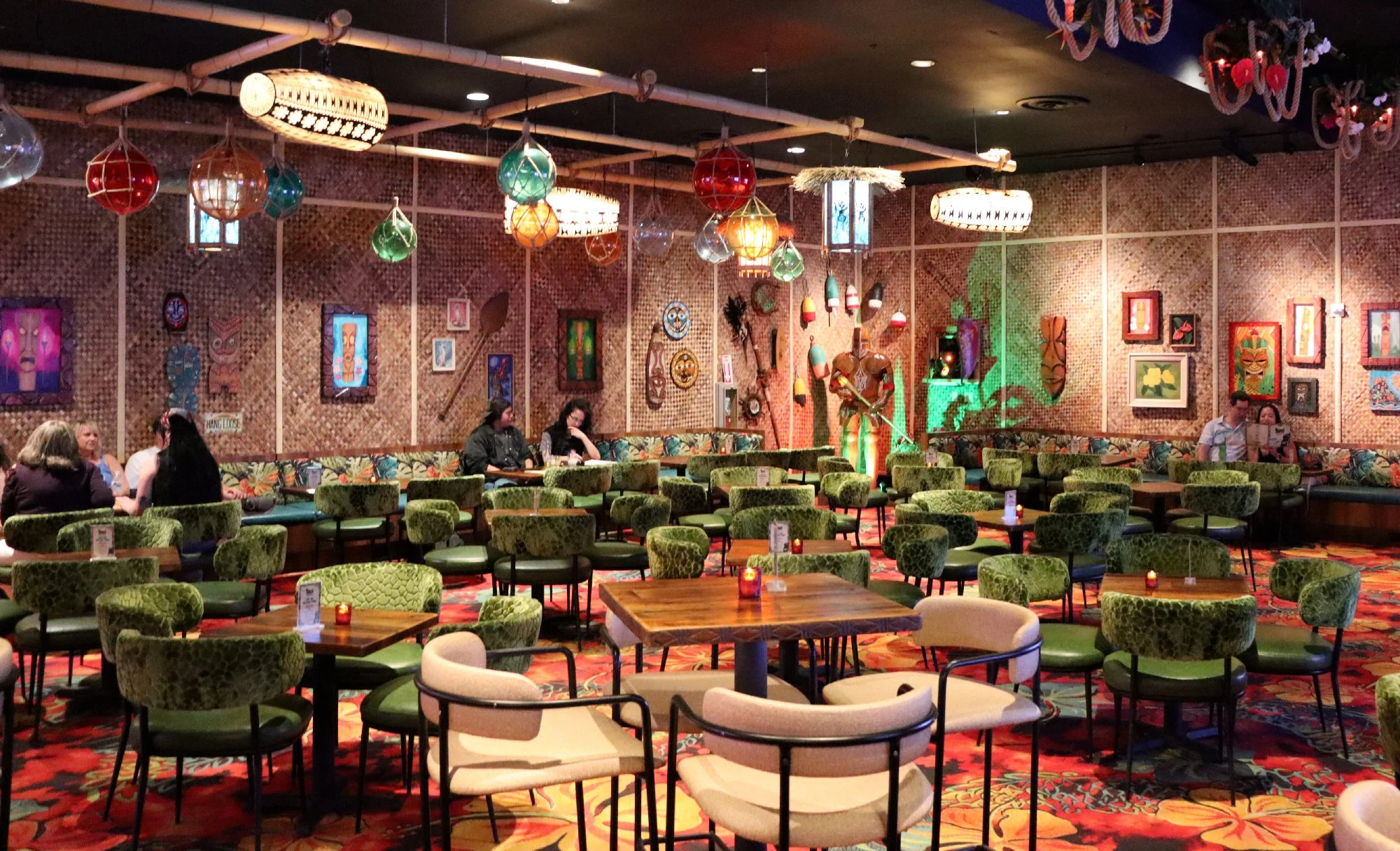
Walking inside, I can see where things start to fall apart. For one thing, it’s way too bright. Lighting is mood; it creates atmosphere. This is lit like a department store showroom. And it’s eclectic. And too pop by far. A mix of 1960s lounge furniture that looks straight out of a SHAG painting crossed with coffee shop tabletops and retro barware spans the floor. Perhaps The Tiki Bar has more life when a live band is on.

I almost missed this bizarre addition in the far corner. I wish I had gotten a closer photograph. It’s a knight in wooden armor holding some kind of torch, like a warrior torn between two worlds. Not very immersive, but strange and fun in a kitschy kind of way.

Some attempts have been made at hanging Japanese fishing floats from bamboo latices, but it’s nowhere near as successful as over at the superior Glitter Gulch.

The boundary on the left side of the entrance is formed by this dual rattan throne, or peacock chair, and ton of fake potted plants. Fern bar, indeed.

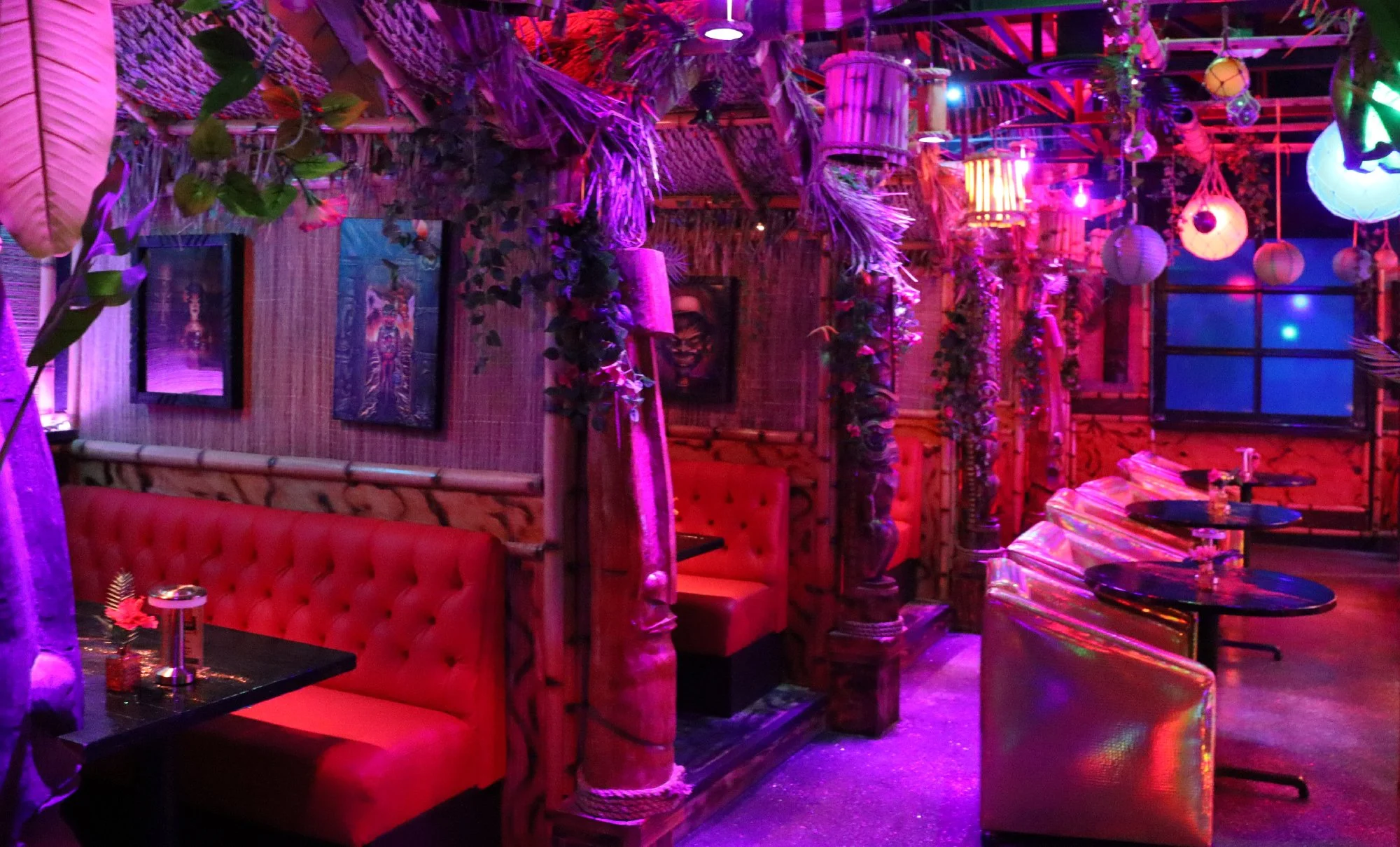
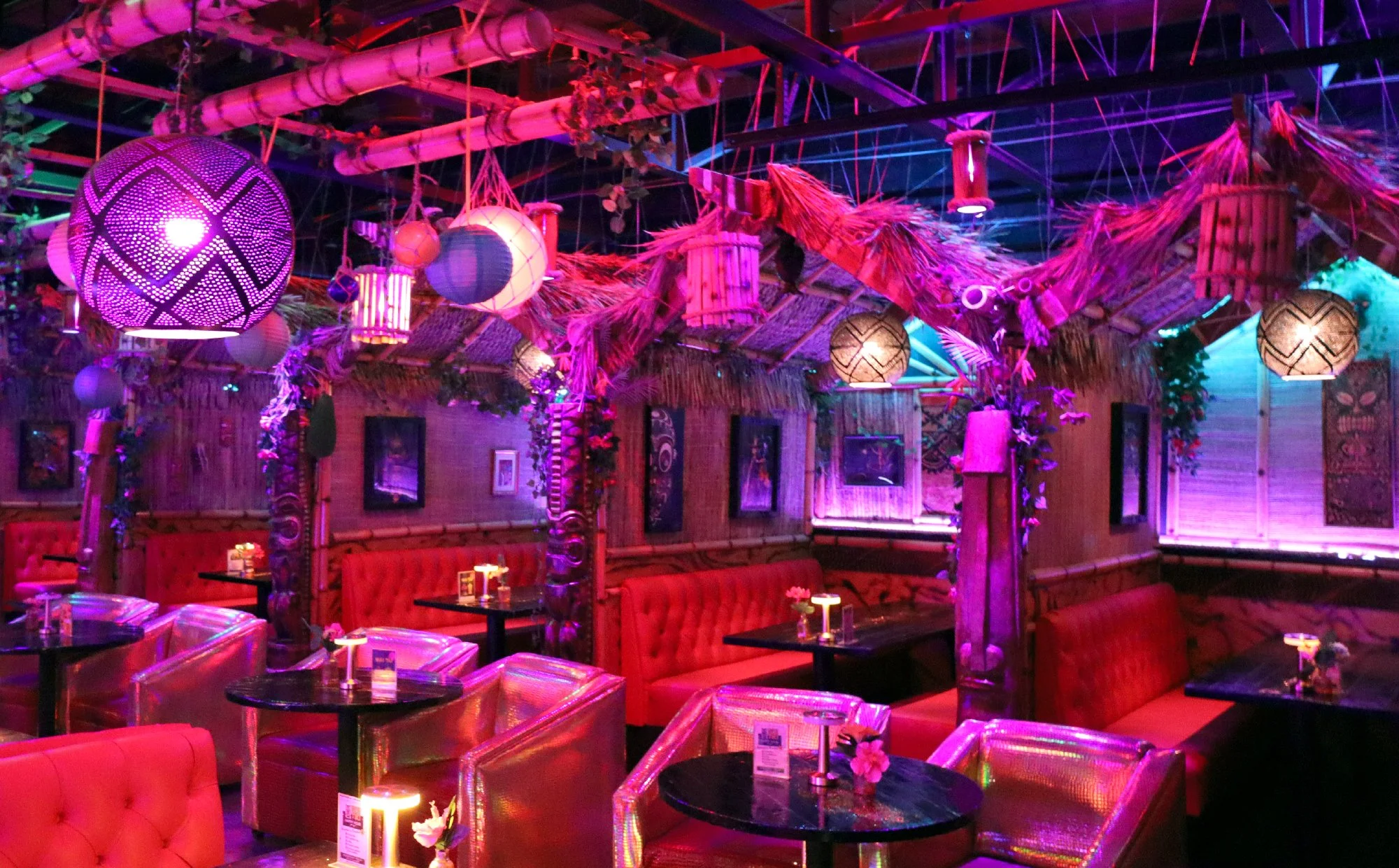
The thatch and bamboo roof is similar to the one at Golden Tiki and indeed many such bars. But the bright lights and multiple sports games on television makes it feel like I’m on a cruise ship.

The tiger print chairs are a fun touch. Very Vegas. Still, this is what happens when thematic design which is usually executed immersively breaks down into the trappings of a style. It’s when a theme becomes mere decor.

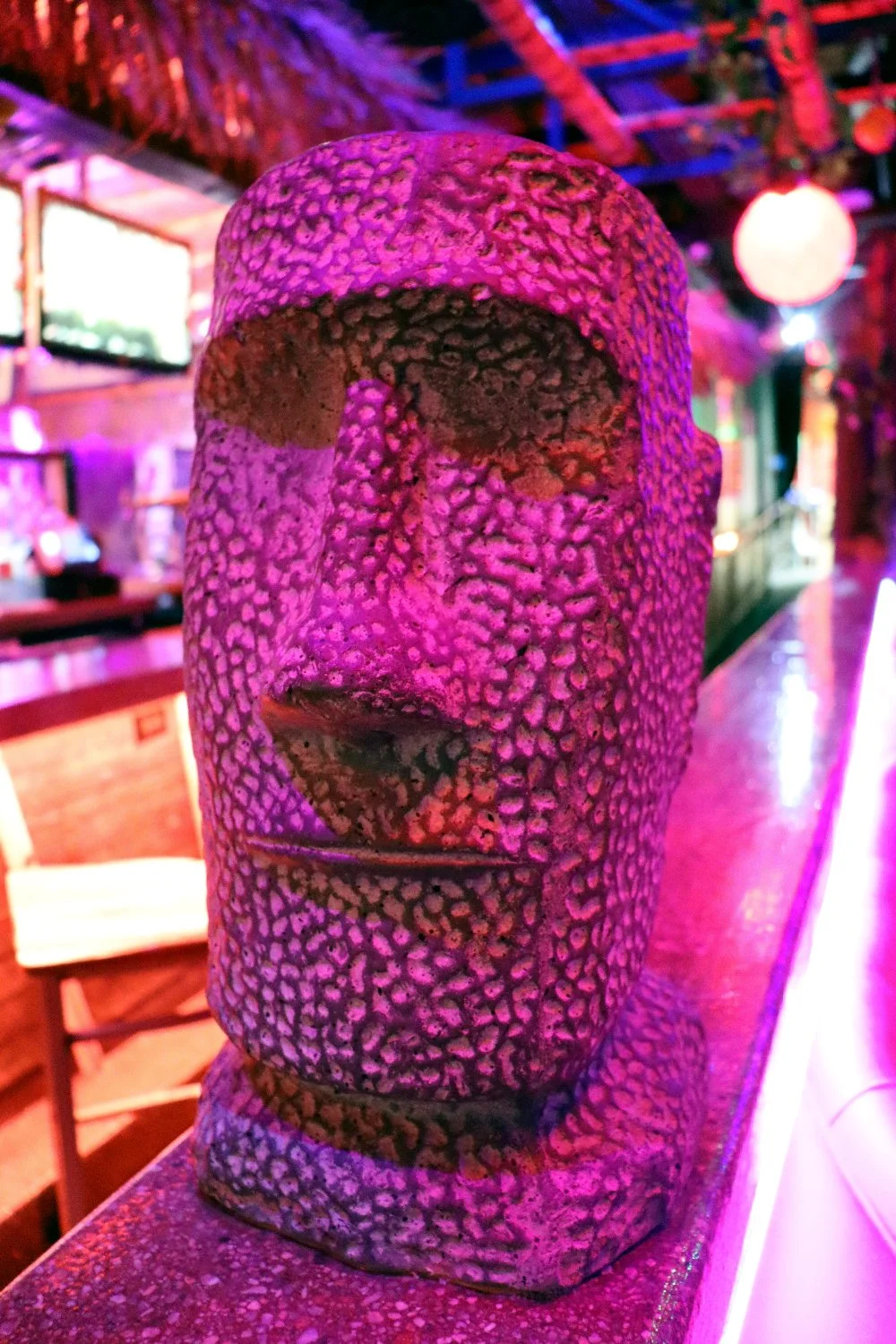
There are occasional authentic flourishes, like these carvings at each corner. And the hanging light fixtures up inside the bar’s roofline are actually quite nice. But unlike within a truly themed space, there is no gestalt. The parts, the rich details often so subtle they are not noticed at first, just do not add up to exceed the sum. It feels much the opposite; an empty shell where those few highlights that are good and do stand out instead call attention to how the whole thing isn’t working very well. An album that doesn’t hit beyond the singles.

The Tiki Bar at Excalibur feels exactly like what it is—a cash-in on a trend that has stretched a bit long in the tooth, and a half-hearted one at best. Many point to the genesis of the twenty-first century Polynesian Pop revival as the opening of Alameda’s Forbidden Island in 2006. That would place us two decades in, roughly following the same timeline as the original mid-century trend.

Is a bar like this, as my buddy suggests, one more sign that we are past peak Polynesian Pop revival? Perhaps so. But The Grand Tiki is slated to open off The Las Vegas Strip sometime soon. Bamboo Ben has been working on the project since 2025, and at over 10,000 square feet of immersive thematic design, it looks to be the real deal.

August 29, 2026 /Dave Gottwald

Polynesian Pop Vegas - Part 5: Glitter Gulch Tiki.

August 24, 2026 by Dave Gottwald

Stray Pirate must have stirred some competitive juices in the Las Vegas cocktail community, because although it and Frankie's Tiki Room are both located closer to downtown, there has been no actual themed Polynesian Pop destinations at the Fremont Street Experience until Glitter Gulch Tiki opened in 2024.

This site on North Fourth Street at Fremont was once the Topless Girls of Glitter Gulch strip club which closed in 2016. It was the owners of the now adjacent upscale Nacho Daddy Mexican restaurant and bar who decided to bring some tiki to the area by relocating just north.

This is fitting, since the Street Experience was designed by architect Jon Jerde, whose firm has dabbled in thematic design of various kinds all over the world, including Treasure Island and the Bellagio right here on The Strip. Jerde had even proposed a mixed use themed development called Urbanopolis for Disney’s aborted Westcot project, and regularly cited Disney as an influence.

Glitter Gulch, of course, is the original nickname of Fremont Street going back to the earliest days of Las Vegas. It even looks good in neon. The wordmark for the bar is set in Hut, one of the faces in the House Industries Tiki Type font collection.

I love this large neon scorpion on the side alley wall sipping a cocktail. It’s a reference to one of the mainstays of mid-century tiki bar culture—the Scorpion Bowl as popularized by the Trader Vic’s chain. The grayscale cartoon character pattern behind reminds me of the iconic 1980s murals of artist Keith Haring, and may have remained from when this building was Nacho Daddy.

Although there is no liminal entrance space, like the wonderful cove grotto at The Golden Tiki, the immediate shift to the themed environment from the street outside is effective. Immediately to the left is the corner of the central bar framed by a large totem carving.

To the opposite side is a row of thatch-roofed booths similar to the other Polynesian Pop establishments in town. It makes sense that Glitter Gulch reminds me of Golden Tiki and Stray Pirate, because once again Bamboo Ben was hired for the interior work and this time also enlisted the help of his son, Blake Basshem.

Here you can see the bar and booths’ relationship to the front door. The way the space is bisected is very similar to the layout of Golden Tiki.

And Glitter Gulch shares many of its vibes. But the bar is closely attuned to what visitors to the Fremont Street Experience expect. It’s less immersive, less Disney-like, and more of a “clubby” atmosphere.

Glitch Gulch is not designed for tiki die hards, not by a long shot. But there are subtle touches. All the flat screen displays around the bar show a silent loop of tropical beach footage, old surf movies, and various clips of Polynesian Pop-related media.

This is in contrast to Nacho Daddy next door, which serves up an endless stream of loud, obnoxious televised content, from reality shows to sports and FOX News.

The lighting is also exceptional, and reminds me of Golden Tiki. It’s not as subtle as Stray Pirate, though. Glitter Gulch is not immersive in that way. This is a bar that is basically self-aware. It winks at you through the forth wall of the design.

The rear wall resembles the rattan panels of Golden Monkey Tiki Lounge. The decor back here is more restrained and, like that bar, reminds of a retail design. Classy.

Some of lighting feels more like a pothead college dorm room though. I half expected to walk through strings of hanging beads to reach the restrooms. Especially with the fabric patterns behind amid the panels of mirrors, it’s kind of tacky.

The hanging fixtures that Bamboo Ben provided are first rate, however. Like at Golden Tiki, the upper rafters beyond the decor recede into matte black. It’s that deliberately unfinished (and inexpensive) look pioneered by nineties chains like Urban Outfitters.

As per usual I end with the gift shop. There was a nice array of tiki mugs for sale, both generic Tiki Farm models and custom pieces.

Glitter Gulch is a good example of the malleability of a theme like Polynesian Pop. It can be pushed and pulled in different directions depending on the intended audience. Golden Tiki and Stray Pirate have been designed for true aficionados. Golden Monkey is for a more upscale crowd. Frankie’s features wonderful contemporary interpretations of mid-century tiki tropes, but it’s positioned as much for fans of the genre as punkers, bikers, video poker addicts, and local drunks.

This was a mixed bag. A solid thematic design executed by one of the top craftsmen working today. And yet there is a trashy, sleazy vibe here too. Aimed more for the tourists, the frat bros, and the bachelorette parties. In deference to them all, what I really appreciated most was the bar’s extensive late-night food menu.

Continued in Part 6.

August 24, 2026 /Dave Gottwald

Polynesian Pop Vegas - Part 4: Stray Pirate.

August 02, 2026 by Dave Gottwald

At the advice of my good friend “Tiki Teacom,” I decided to check out one of the newer tropical watering holes in the Las Vegas Arts District during my visit, Stray Pirate. I'll elaborate below why I feel the establishment counts as Polynesian Pop, though, because founder Chris “Tater” Gutierrez was quick to note soon after its fall 2023 opening that “We’re not actually a tiki bar. There are no tikis in here. We’re very careful about doing that. We’re looking for this place to age well.”

As such the emphasis is on pirates and nautical decor. The exterior consists of stylized shipping crates with oversized rope. It’s almost cartoonish.

Quite the spiffy logo on the flag flying overhead. You can’t have pirates without flags! The type appears to be from the venerable Letterhead Fonts Company. Their faces are used frequently at the American Disney parks. This lettering would be from the 1800s–1900s collection, the same one the Imagineering graphic designers use. If I were to guess I’d say it’s based on Hensler 2.

The storefront itself reminds of the 826 Valencia Pirate Supply Store in the Mission District of San Francisco. It’s playful. This prop canon looks like it came right off Disneyland’s Pirates of the Caribbean. But the presentation is not realistic.

And yet once you walk inside, you’re within the hull of a sunken ship. It’s a completely immersive environment full of credible materials, elaborate props, and dramatic lighting. All the essential components of a themed space.

To my right are a line of portholes with digital flat screens behind them displaying underwater footage on a slow loop. There is rope and other nautical riggings everywhere.

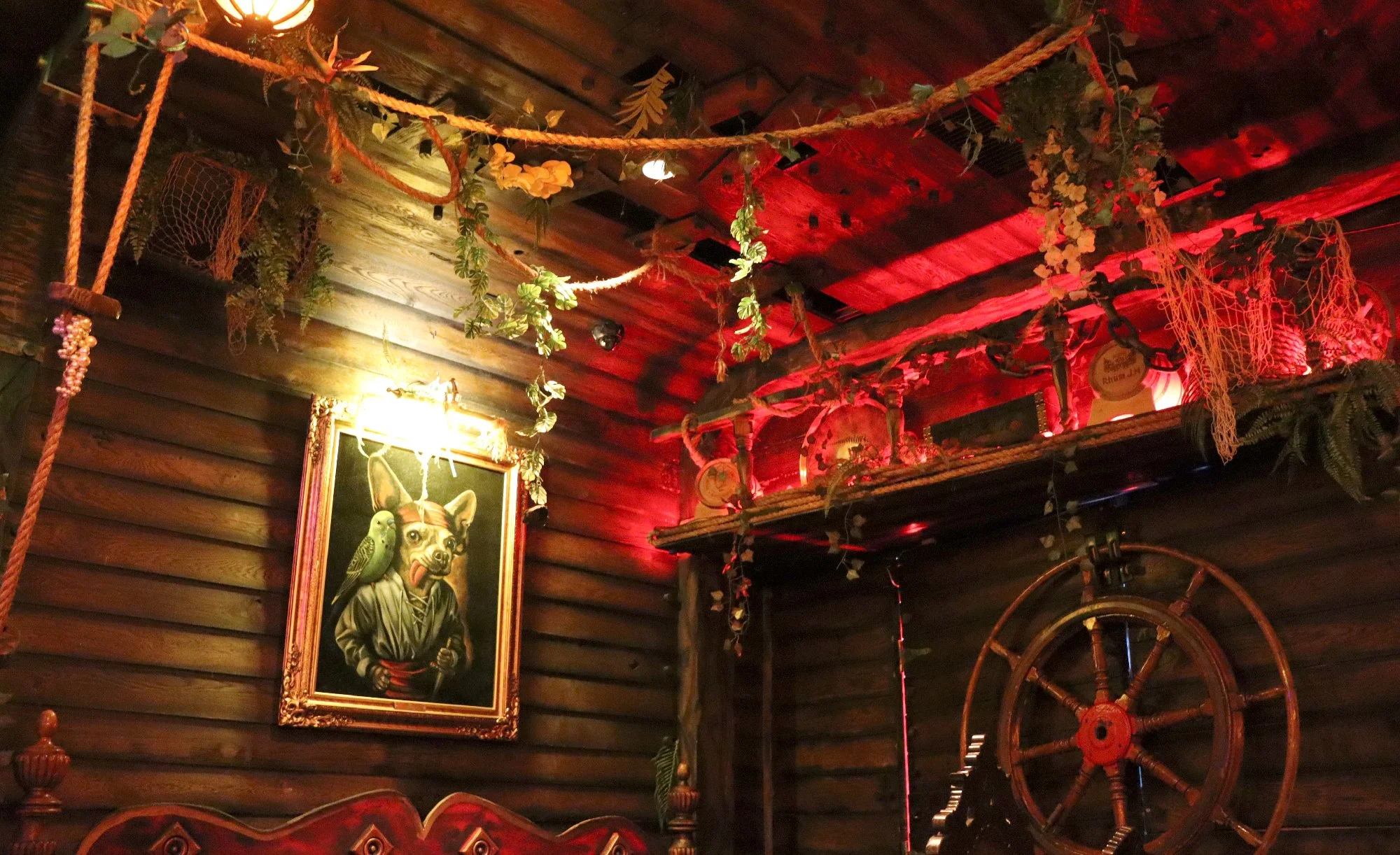
I also spot the first of many dog pirate portraits.

To my left is a bank of booths very similar to those at Golden Tiki. That’s because “Bamboo Ben” Bassham was again tapped to provide the interior design. The enclosures over the seating are less of a island shipwrecked vibe, though. It’s more like everything is actually part of the vessel around us.

One recurring pop culture reference here is to the classic 1985 teen adventure comedy The Goonies which features much pirate lore.

The lighting inside Golden Tiki was pleasant. But here at Stray Pirate it’s even more atmospheric. More natural. There’s a lot more subtlety.

These lines of hurricane lamps contain LEDs which flicker softly.

Behind the bar is another series of much larger digital flat displays. The edges are irregular, as if the wooden planks lining the walls have been broken through.

The video loop is synchronized across all the screens, so the effect is one long vista of multiple portals. Fish and other sea creatures swim by. There are streams of realistic bubbles amid a variety of props. It’s a bit like an aquarium yet not.

All of the furniture seems to have been pillaged from inside an antique Spanish galleon. The backing of the booths along the wall is comprised of headboards. The chairs are mismatched. All the upholstery is a deep, velvety red.

The lighting fixtures aren’t limited to hurricane lamps either.

For example, there are plenty of the tropical trope I found at both Frankie’s and Golden Tiki—the lighted glass Japanese fishing float. This is one reason why I’d still call Stray Pirate a Polynesian Pop establishment.

Look at the amount of fishing float lights and flower leis hanging from the ceiling to the left. And contrast this with the glow of the hurricane lamps above the bar to the right. There is a melange at work here. A mixture of nautical notes with tropical vibes.

The bar area becomes its own environment, separate from the rest. There’s some effective mood lighting here, awash in reds, which contrasts with the blue hues of the underwater displays.

And some unique props, like this faux antique hardcover book (likely resin) with custom pirate map illustration. X marks the spot, of course.

Just to right of the end of the bar is another dog portrait. This one reminds me of a character from one of Wes Anderson’s stop-motion animated films.

Similar to Golden Tiki, the restroom area is its own separate enclave with unique themed elements. Here, a darkened blue grotto. There is a treasure of gold bars spilling out onto the floor below a wall of elaborate rockwork.

You can take a seat on the bench alongside this long-departed soul while you wait to relieve yourself.

There are two bathrooms, each with a unique theme. Both mermaids and pirates are welcome.

Here the Disney tributes are more explicit. This is the actual map once passed out at Disneyland for Pirate’s Lair, the 2007 rebranded version of Tom Sawyer’s Island.

And here are the lyrics for the famous theme song to the Pirates of the Caribbean attraction, typeset in what looks like a face from Letterhead Fonts Company again.

A great joke here above the toilet. I hope I don’t need to explain it. Hint: this is a unisex bathroom.

The second restroom is regal and elegant. Here are the rest of the dog portraits similar to the ones out in the main space. Stray Pirate founder Chris Gutierrez says that “our backstory is that these pirates were sailing along and they all got cursed and turned into dogs, but in doing so found their true treasure to be loyalty and camaraderie.”

All are the work of California artist Gwen Rosewater, who has executed over 500 dog portraits. Gutierrez commissioned the paintings as representations of his and his investors and staff’s pets.

The power of this liminal space is, like at Golden Tiki, evident when you make your way back into the bar. Bamboo Ben appears to have several design techniques which he repeatedly draws upon for his different projects.

Naturally, there is merchandise available, here displayed in appropriate glass cabinetry. Mugs, glassware, and various apparel items, all thoughtfully designed.

Though the founder of Stray Pirate is weary of the “tiki” moniker, this is a themed Polynesian Pop bar—of the Caribbean nautical variety—par excellence. It reminds me a lot of Undertow in Phoenix, Arizona, where the emphasis is on piracy on the high seas rather than statuary, carvings, and the islands of the South Seas.

Continued in Part 5.

August 02, 2026 /Dave Gottwald

Polynesian Pop Vegas - Part 3: Golden Monkey Tiki Lounge.

July 27, 2026 by Dave Gottwald

The next stop on my Polynesian Pop tour of Sin City is yet another golden establishment as it turns out—Golden Monkey Tiki Lounge within Resorts World Las Vegas (2021), the first new resort completed on the Strip since Cosmopolitan (2010).

The name, icon figure, and typeface all conjure up visions of the Far East, perhaps Indochina, and under colonial rule at that. The bar opened in 2023 as a redesign of the prior lounge from two years earlier attached to the adjacent Genting Palace Restaurant. One review noted this was because it was “too formal and intimidating for their lounge to see casual traffic from people not interested in dining.”

Golden Monkey was the first bar with a tiki theme to open on the Las Vegas Strip proper since the ill-fated Taboo Cove at The Venetian. The vibe is very upscale, fitting with the other restaurants within Resorts World (which, I chuckled to myself, seems like such a rip-off of Walt Disney World).

True to form, the entrance is flanked by two unique tiki god statues.

They appear to have been standard models supplied by Oceanic Arts, which for 65 years was the leading purveyor of Polynesian Pop carvings and associated decor. In fact, I have a similar figure in my own home which I purchased there in 2011.

The space is quite attractive, but again more luxury resort than tiki bar. Golden Monkey is a good example of when theming becomes more of an interior design motif. Environments like this are not experientially immersive, I would argue, because you do not feel truly transported to another time and place.

There are also many abstracted elements, which again detract from immersion. At the Golden Tiki Lounge, such moments are interwoven with more deeply rendered thematic touches, and as such contribute to an overall fantasy other-worldliness.

But when they appear isolated, like these enlarged metal cages with flat, toy-like plastic monkey shapes trying to escape, they read almost as branded elements.

The furniture is well-considered with varying pillow patterns and top arm rails that curve downward suggesting, again, an Asian influence.

I noticed octopus-shaped LED candle holders and some typical tiki mugs left by recently-departed patrons.

Octopuses appear to be a recurring notion throughout, though what connection they have to the namesake monkey theme I have no idea.

The woven rattan is fine and restrained. Playful dimensional masks in abstract frames are sprinkled about the walls. I can imagine some affluent guests finding this rather tasteful compared with the more-is-more, cluttered and packed-to-the-gills approach that many contemporary bars like Golden Tiki take.

There are notes of Polynesian Pop environments gone by, such as these oars, but always with a measure of restraint.

It almost feels like the staging you’d find in a retail space. Tommy Bahama comes to mind.

The bar area itself is the “most Las Vegas” part of Golden Monkey Tiki. I did appreciate that the large flat screen television was turned off. I’m assuming it’s there for when there is a major sporting event. The seats are plush red and match the abstract mosaic of circles framing the display.

A unique tiki stands at either side.

For whatever reason, both are adorned with a single starfish.

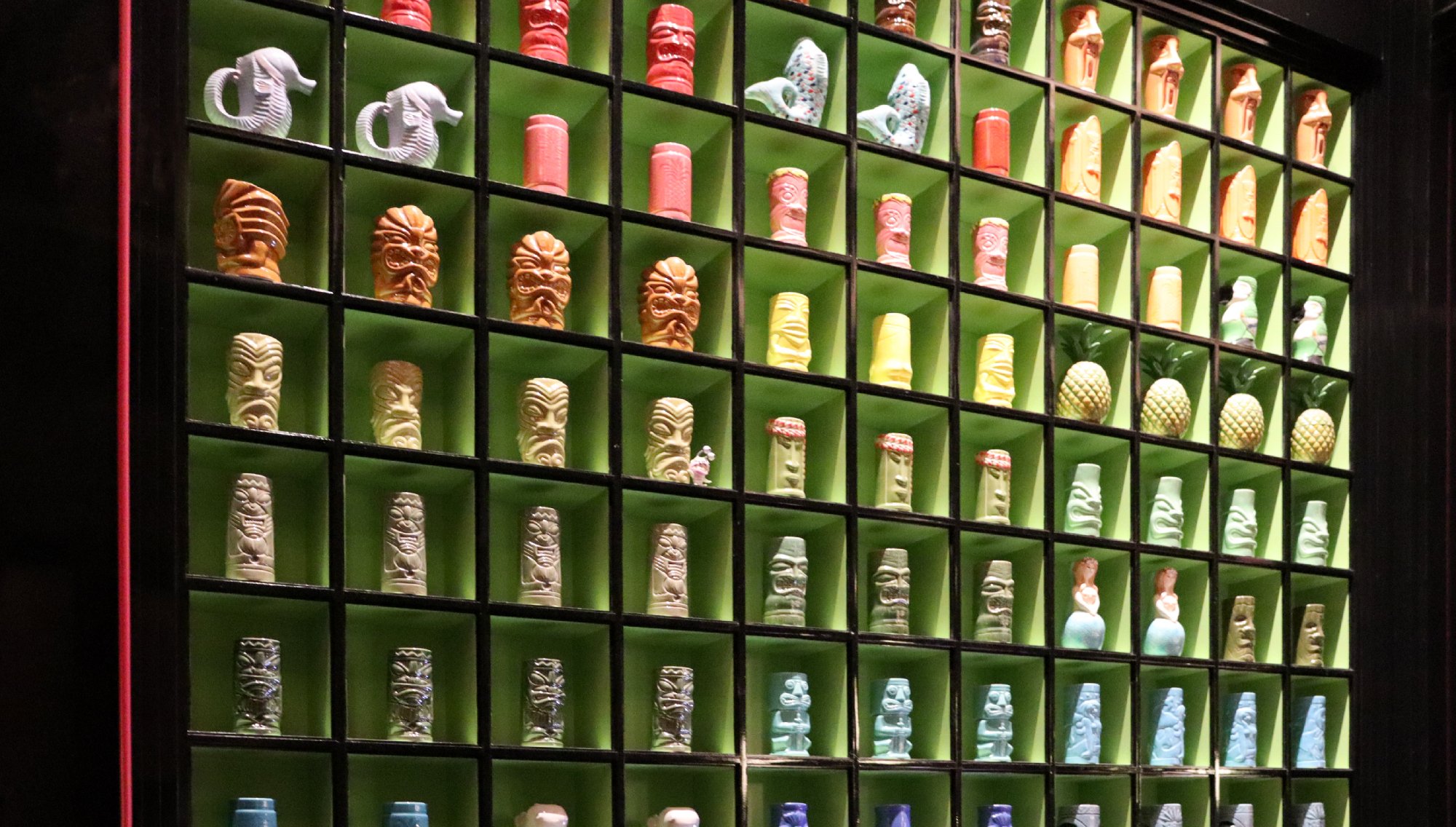
I thought these were really interesting. There are two banks of tiki mugs displayed in a tall green grid to the left and right of the bar. I recognize some as Tiki Farm originals and others as more generic designs. Many of them are duplicated in pairs. It’s a really inexpensive way to express the theme of the space in a visually interesting way. And, again, it’s the kind of interior decor you’d find in an upscale retail environment.

The presentation rhymes with the bar’s largest abstract element, this towering palm tree column.

At the far end just to left of this palm is a glass portal that faces the hotel hallway outside, flanked by foliage as well as flat graphics.

It’s a very club-like environment, and one that I would not classify as thematic design. The space has a theme (or themes), but everything is expressed through traditional interior decor. The Golden Monkey Tiki Lounge, though attractive, is not a truly immersive space. I don’t feel like I have been transported to another time and place.

True themed spaces resemble film sets and employ their visual grammar. Golden Monkey Tiki has many charming elements, like this hula dancer above, but it’s more an exercise in traditional interior design. Moreover, the mug display turned out to be a tremendous tease. They have no custom designs, and through the bar staff will sell you the one you just drank out of, the price is ridiculous.

Continued in Part 4.

July 27, 2026 /Dave Gottwald

Polynesian Pop Vegas - Part 2: The Golden Tiki.

July 21, 2026 by Dave Gottwald

Frankie’s Tiki Room was the lone Vegas Polynesian Pop mecca for nearly a decade. Then The Golden Tiki arrived in the city’s Chinatown during the summer of 2015. Located in a small strip mall called The Center at Spring Mountain, the bar replaced an establishment called Little Macau.

Founded by former Hard Rock Hotel creative director Branden Powers, Golden Tiki was heavily inspired by Disneyland. It represents a step forward in themed immersion, more like the classic tiki temples of mid-century like the Aku Aku than Frankie’s. Yet with a contemporary twist and a wink and a nod to popular culture.

Case in point are the carved shields out front. The art is playful rather than attempting to channel legitimate South Seas vibes. In the center is the Golden Tiki mascot.

There is a mixture of signage outside, like this strange arrowhead form with Western wood typography. Like Frankie’s, Golden Tiki is open 24 hours and you can gamble.

Because it’s located within a strip mall, the bar still sports the standard fin that all the business tenants of The Center at Spring Mountain use.

The carvings on the door handle pulls look like the more traditional figures found at places like Trader Vic’s, even though they, too, are Americanized pop interpretations. This is one of the interesting aspects of tiki theming. Something can be called classic or traditional, and it’s referring to tiki’s own mid-century past rather than anything actual authentic to Pacific Islander culture.

Immediately upon entry, the Chinatown of Las Vegas disappears behind me. Themed environments are famous for transitions, liminal spaces, and thresholds. This is what Golden Tiki calls a “secret lava rock cave entrance with waterfall.” It noticeably cooler than the night desert air. I can feel the humidity of the water trickling down. The lighting effects shimmer. I almost feel and hear a slight breeze. I’m transported.

To the right as I walk in is a Tropical Trading Outpost, one of the many tropes of Polynesian Pop. Again begun by Trader Vic’s, there were many, many tiki bars using a Trader moniker, including Trader Dick’s, Traders Inn, Trader Ku's, and most recently the Disneyland Resort’s own Trader Sam’s (2011). A hand-painted sign reads BUY-SELL-HOCK-TRADE and there are various crates and cages filled with antique and vintage bric-a-brac, including the Central American idol from Raiders of the Lost Ark (1981).

As is customary, there is always a tiki or two at the foyer to greet us. A total of twenty-four carvings like this one were executed by Bosko, who had done the same for both Taboo Cove and Frankie’s.

Immediately I can tell this is quite the cut above any tiki bar I’d yet seen in Las Vegas. The amount of detail is simply stunning. The central bar is roofed in thatch, common enough, bur everything is deliciously backlit. This is a space to drink in just as much as the cocktails.

Around to the left are some booths enclosed by fort-like bamboo structures. Again, this is common in Polynesian Pop environments. The design provides a measure of intimacy but also a sense of inhabitation, like we are living on a tropical island in a makeshift assemblage of our own creation. Perhaps we were shipwrecked here.

Just to the right of that along the wall is a series of cartoonish clamshells from which water cascades. The bar calls these, tongue firmly in cheek, Seamen Falls.

Walking around, I notice that Golden Tiki is a series of four interlocking lounge spaces that each carry an individual yet related theme.

For example, this is The Pirates Lair, which deeply channels Disney lore. There is an Audio-Animatronic figure above at the left (not sure if it’s a replica or an actual retired park attraction figure). The amount of propping, especially above my head, is impressive. I love that every space has multiple levels of detail, like this shelf above the booth areas carrying a painting and a skeleton locked up in a jail cell.

Everywhere you turn, the theme shifts slightly. But if you’re a fan of tiki in general, and the Disney parks more specifically, there are many not-so-hidden tributes to take in.

Along the wall to the right side as you enter The Golden Tiki is a series of typical A-frame thatch hut seating areas which are meticulously decorated. Though these date back to mid-century tiki establishments, the contemporary version of the trope is far more involved.

The lighting, in particular, is exquisite.

Each hut features a unique wall carving.

Again, these are more playful than authentic.

This one especially reminds me of Rolly Crump’s work on the original Walt Disney’s Enchanted Tiki Room.

Coming around to the rear corner of the central bar I notice another skeleton. There are several of them sprinkled throughout, often to humorous effect, which of course suggests to me Disney’s Pirates of the Caribbean.

And just above I notice something else. Even more Disney magic. There is an LED starfield embedded in the black ceiling, and periodically fiber optic fireworks erupt. The loop is long and the effect is subtle. You have to look up for a while to catch them.

A different Bosko tiki god guards each corner of the bar, along with a ship’s bell to announce things like a special drink order or last call. The torches, which appears to be LED, flicker realistically.

While I’m gazing starward, I notice a number of round lamps. They are based on another tiki trope dating back to the first Don the Beachcomber bar in Los Angeles which was later adopted by Victor Bergeron for his Trader Vic’s chain—the glass Japanese fishing float, called buoy balls (ukidama, 浮き玉) or glass balls (bindama, ビン玉). These were used as tropical decor, and during the tiki revival morphed into colorful light sources.

What’s clever here is how they’ve been installed. Many tiki establishments hang such lamps from a simple wood lattice structure. But here a small fishing boat has been hung upside down as their enclosure. It’s moments like these that remind me that the theming at Golden Tiki is meant to be immersive, but not necessarily realistic. There is a playful level of abstraction at work as well.

In such a fantasy setting, not unlike a film, cultural appropriation, misattribution, and/or stereotyping is not much of a concern. For example, the bar’s DJ booth is lined with skulls mounted on spikes in reference to the Jungle Headhunter trope.

The hallway leading to the restrooms at the rear of Golden Tiki is lined with bamboo-framed rattan and decorated with artworks and props.

Along with a mixture of weapons and other genuine artifacts are literary references like to the Monkey’s Paw.

Most stunning is the glass vitrine containing only some of the 250 custom shrunken heads created for Golden Tiki by Wyoming-based artist Terry Barr.

The ones in this case pay tribute to many famous figures of classic Polynesian Pop and its contemporary revival. I spot Bob Van Oosting and Leroy Schmaltz of Oceanic Arts which for 65 years was the leading California purveyor of tiki carvings and decor. Then there’s SHAG (aka Josh Agle), an illustrator and painter of mid-century style who has executed many works in the exotica genre, including many commissions for Disney. Speaking of, also sitting in the case is Disney Imagineer Bob Gurr, the last original one, as of 2026, still alive who personally worked with Walt Disney on Disneyland.

I see Vic Bergeron, founder of Trader Vic’s, representing the old guard. And Sven Kirsten and Otto Von Stroheim, tiki historians, as well Holden Westland, founder of Tiki Farm, the world’s largest current supplier of custom tiki mugs, symbolizing the current one.

A few shrunken heads I couldn’t place. But some were quite incongruous, like David Bowie as Gareth from the 1986 fantasy film Labyrinth.

Like any good themed space, the transition from the restrooms hallway back into the main bar area is a well-defined threshold moment of materials and lighting.

The last small Disney touch at Golden Tiki is the presence of Audio-Animatronic birds overhead which reference the Enchanted Tiki Room.

Like the pirate, I can’t tell if these are actual retired figures from the park or credible replicas. But when they came to life from time to time I was charmed.

The Golden Tiki is a perfect example of the twenty-first century tiki bar revival, with its references to classic establishments of Polynesian Pop. Yet also a melange of theme park elements, numerous props and elaborate decor, and an atmosphere augmented by evocative lighting and special effects.

In 2024 the bar celebrated pouring a half million Mai Tai cocktails, in 2025 its tenth anniversary, and shows no sign of slowing down. I’ve visited three times so far, and I am sure to return for an evening of tiki-themed immersion in the future.

Continued in Part 3.

July 21, 2026 /Dave Gottwald
  • Newer
  • Older

All original content on this site © 2007—2026 Dave Gottwald.
My photography is licensed under Creative Commons NonCommercial 4.0.
You are free to use my images for non-commercial purposes only.