
Polynesian Pop Vegas - Part 1: Frankie's Tiki Room.
It’s been five years since I’ve posted about Las Vegas. I last visited during the summer of 2022 for four nights, but that was purely for fun. So when I saw that this year’s University & College Designers Association (UCDA) Education Summit was in town this past May, I jumped at the chance to present. Because I was scheduled for four talks, the conference kept me busy for most of the week. So I decided to narrow my focus and take some deeper dives into the diverse types of theming that Vegas has to offer. One of them being the city’s tiki bars.
Tiki, or as it’s sometimes called by scholars, Polynesian Pop, was one of the themed topic areas of my MFA thesis, and I blogged about it in graduate school way back in 2008. Since then I’ve visited tiki bars all over the world, from Tokyo to Dubai, but by far most of my stops have been in the United States.

Vintage postcard, Aku Aku.
Early Vegas Tiki and the Aku Aku
Sin City’s most famous historical Polynesian restaurant was the Aku Aku at the Stardust Casino and Hotel (1960–1980) that was named for Thor Heyerdahl’s 1957 book Aku-Aku: The Secret of Easter Island. Heyerdahl was a Norwegian zoologist and ethnographer whose stories of South Seas research in The Kon-Tiki Expedition (1948) gave birth to the popular use of the word “tiki.” Several bars and restaurants bearing the Kon Tiki name flourished during the 1950s and 1960s. So it was with Aku Aku.
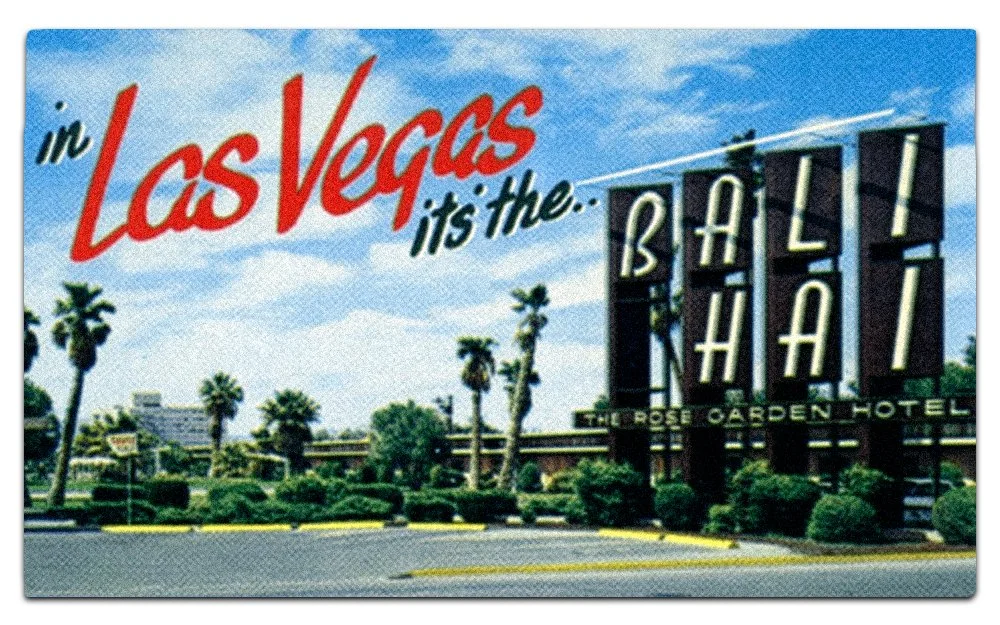
Vintage postcard, Bali Hai.
South Seas theming had appeared like an oasis in the Nevada desert a bit earlier with the 1957 openings of the Bali Hai, a budget-friendly, drive-up motel, and the Tropicana Hotel and Casino. But Bali Hai lacked a restaurant and the Tropicana was more broadly, well, tropical in orientation, calling itself “The Tiffany of the Strip” with much attention focused on the Folies Bergere Paris showgirl revue.
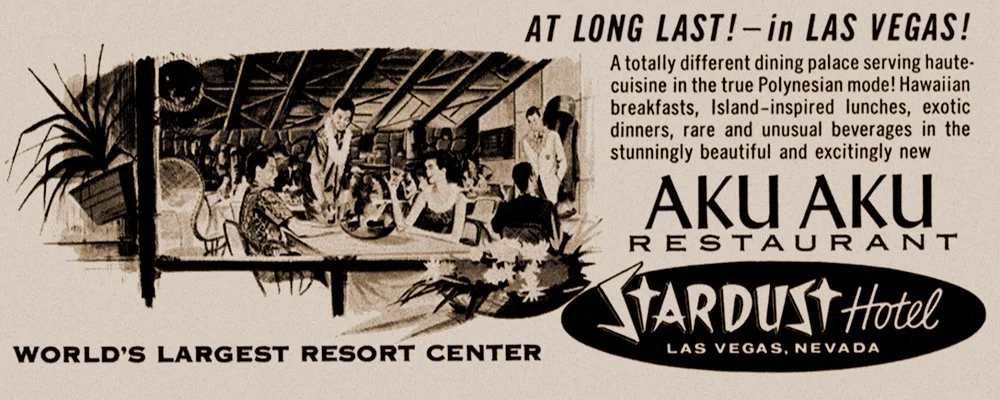
Vintage advertisement for the recently opened Aku Aku, 1960.
When Aku Aku arrived three years later at the Stardust, it thus billed itself as the Polynesian dining trend so popular in Southern California just now arriving. AT LONG LAST! — in LAS VEGAS!
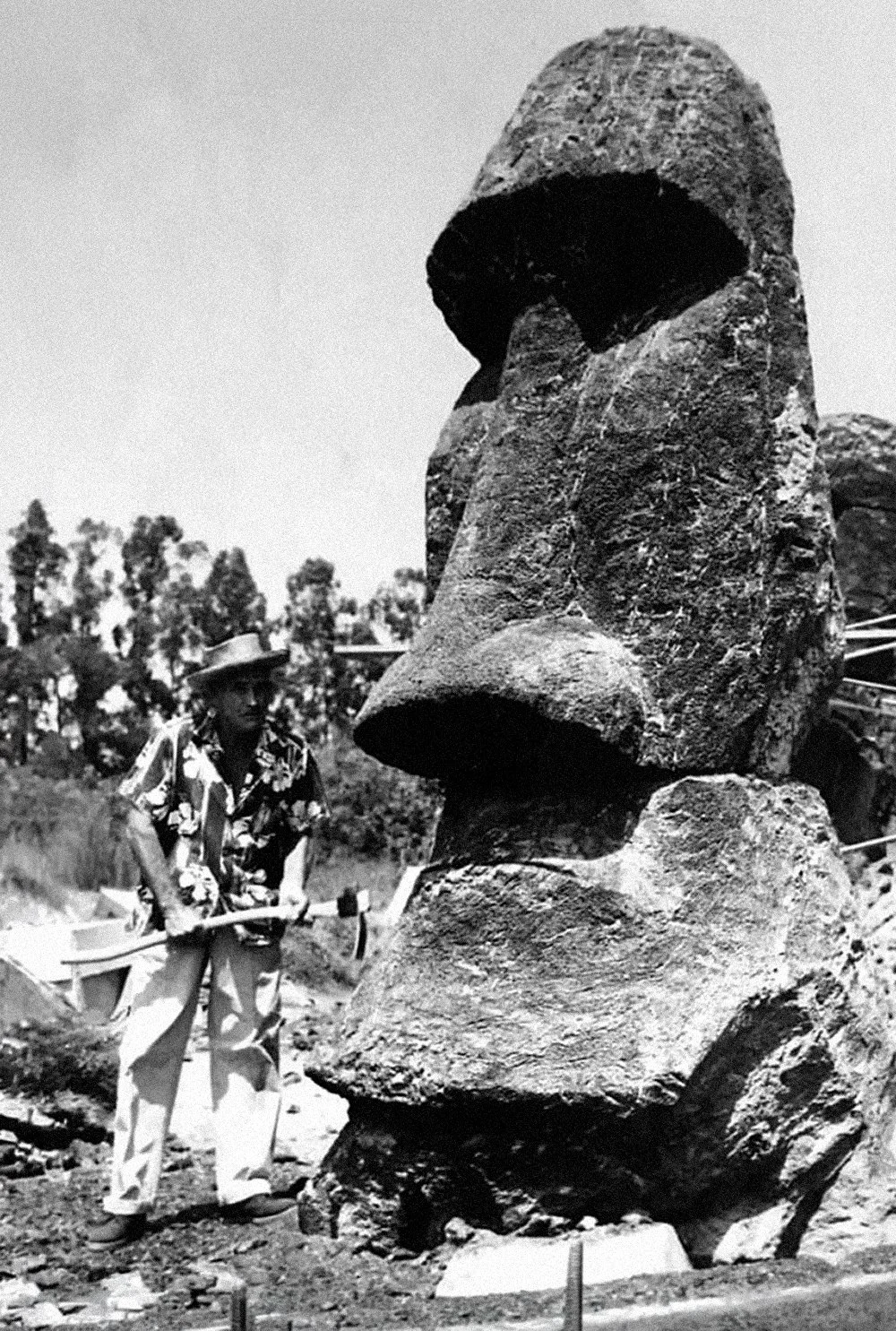
Eli Hedley working on one of his giant Moai carvings.
Aku Aku (which reportedly originally seated seven hundred guests and was staffed with a twelve cooks and two dozen servers) actually had a direct connection to theming’s family tree. Some of its exterior statuary and decor were provided by Weldon “Eli” Hedley (1903–1981), a man known as the Original Beachcomber. Hedley had performed similar services for other South Seas establishments in Southern California as well as the famous Lake Tahoe Polynesian restaurants Trader Dick’s and Harvey’s.
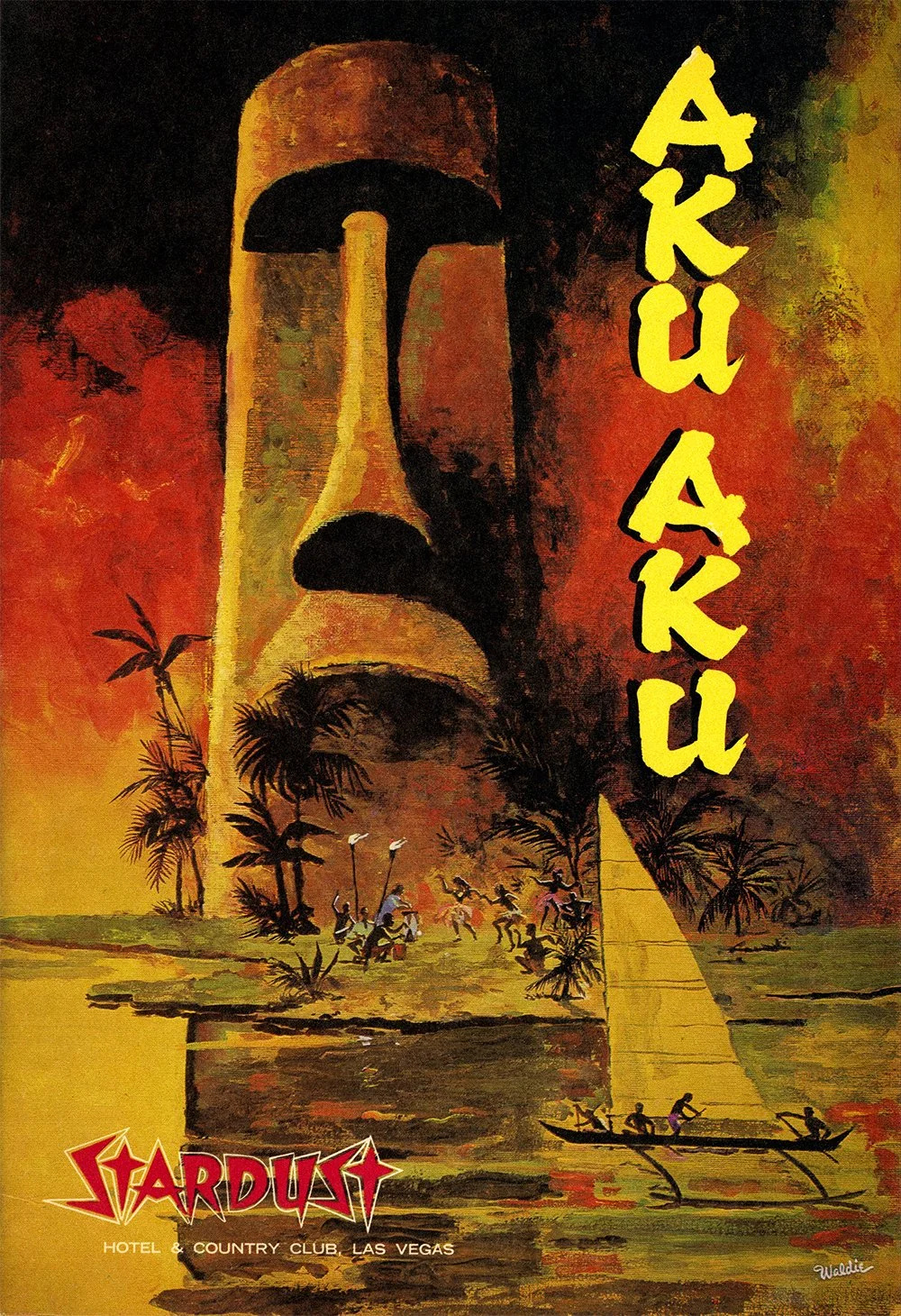
1969 Aku Aku menu cover featuring Hedley’s Moai as the primary icon. Courtesy Los Angeles Public Library.
He was specifically tapped to carve the fifteen-foot black rock Moai (Easter Island) statuary out front, one of which has survived at Sunset Park in southeast Las Vegas on an island at its duck pond.
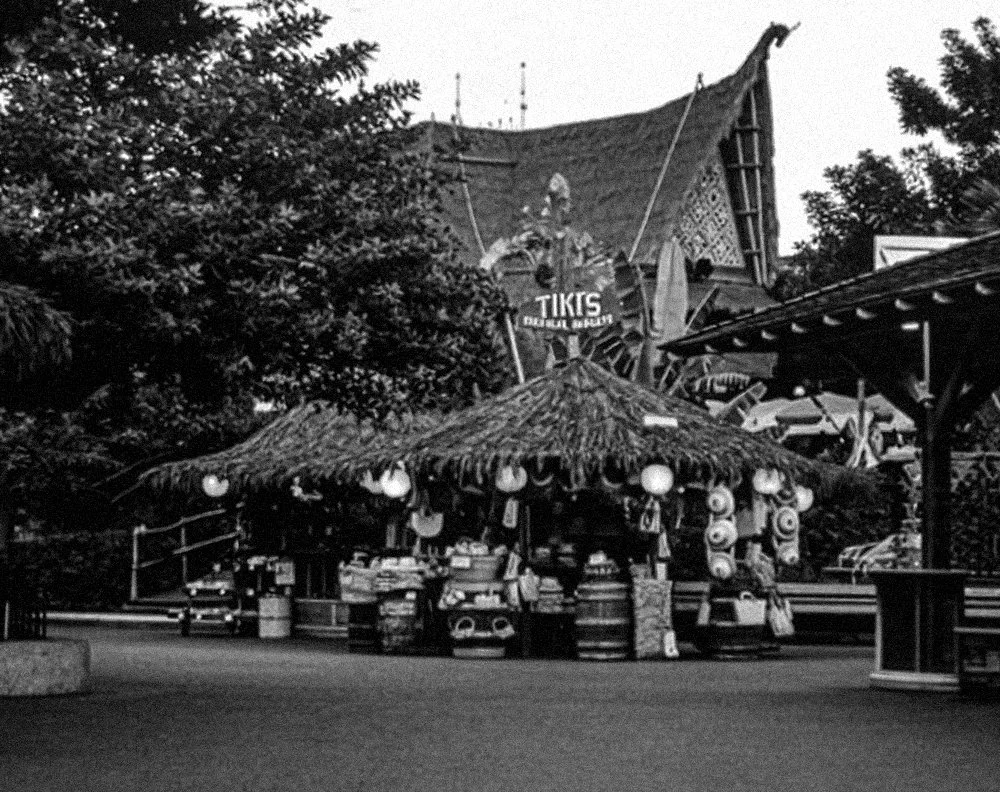
One of Eli Hedley’s three retail stands in Adventureland.
According to the Van Eaton Galleries auction catalog for The Story of Disneyland (2015), Walt Disney had personally hired Hedley to add theming to Adventureland and let him have a concession in the park known as Tiki’s Tropical Traders and later The Island Trade Store:
In exchange for carving early Adventureland tikis and offering general scenic decor, Hedley was given the shop space rent free. Walt negotiated the lucrative arrangement personally. The fine tradition of offering rubber snakes, glowing skulls and shrunken heads to young adventurers continues to this day in approximately the same location as [the] 1950s original.
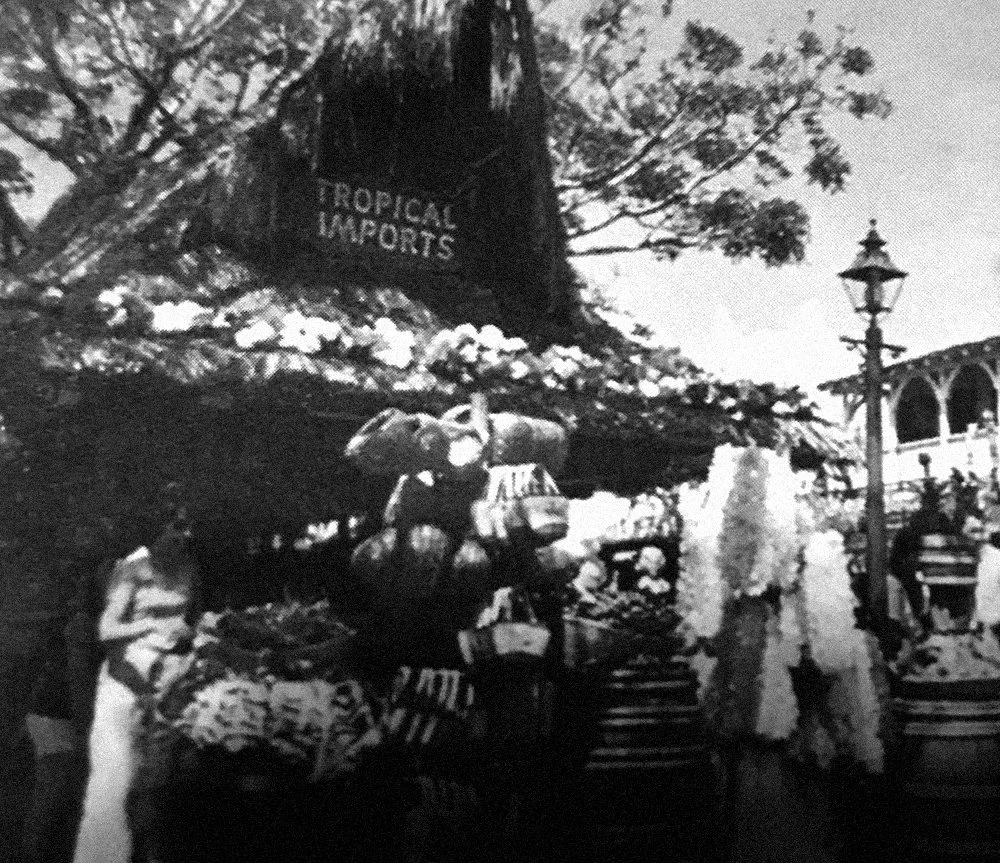
Another of them right next door to the Jungle Cruise.
Prolific Disney parks researcher and writer David Koenig clarifies further in The 55ers: The Pioneers Who Settled Disneyland (2019) that Hedley actually had more than one concession within Adventureland:
Walt hired him to carve a towering tiki for just inside the entrance to Adventureland. Hedley soon found himself operating two spaces inside the Bazaar, one selling tropical trinkets such as tiny tikis, the other selling island-themed jewelry. He later expanded to a third space in the Bazaar.
When asked to provide carving work for the Aku Aku, the story goes that Walt Disney agreed as long as he kept crafting pieces for Adventureland on a farm property across from the park on Katella Avenue and manning his concessions during the day, at night he was free to take on the Stardust contract. From the pages of Liquid Vacation (2013):
Because of the deal with Disney, the sculpting of these monoliths presnted the unique problem of getting the raw materials to a place where Hedley could work on them. The problem was solved when the Stardust commissioned the mining of three thirty-foot blocks of volcanic featherstone from a quarry in northern Nevada and had them delivered to the farm. The finished Moai statues were then shipped to Las Vegas.
So yes, the Aku Aku’s statuary was crafted across the street from Disneyland after hours by a man who helped decorate Adventureland for Walt.

Vintage postcard, Aku Aku.
The restaurant’s bar, known as the Aku Aku Room, served a cocktail menu created by another famed bar owner of Polynesian Pop, Donn Beach (1907–1989), founder of the Don the Beachcomber franchise. Though the Grand Opening was quickly marred by a kitchen fire that destroyed its interior, Beach continued to consult on its rebuild. He once claimed that he was paid for his services by the mobsters who ran the Stardust with two brown paper bags each filled with $50,000 cash (that’s over one million dollars today).
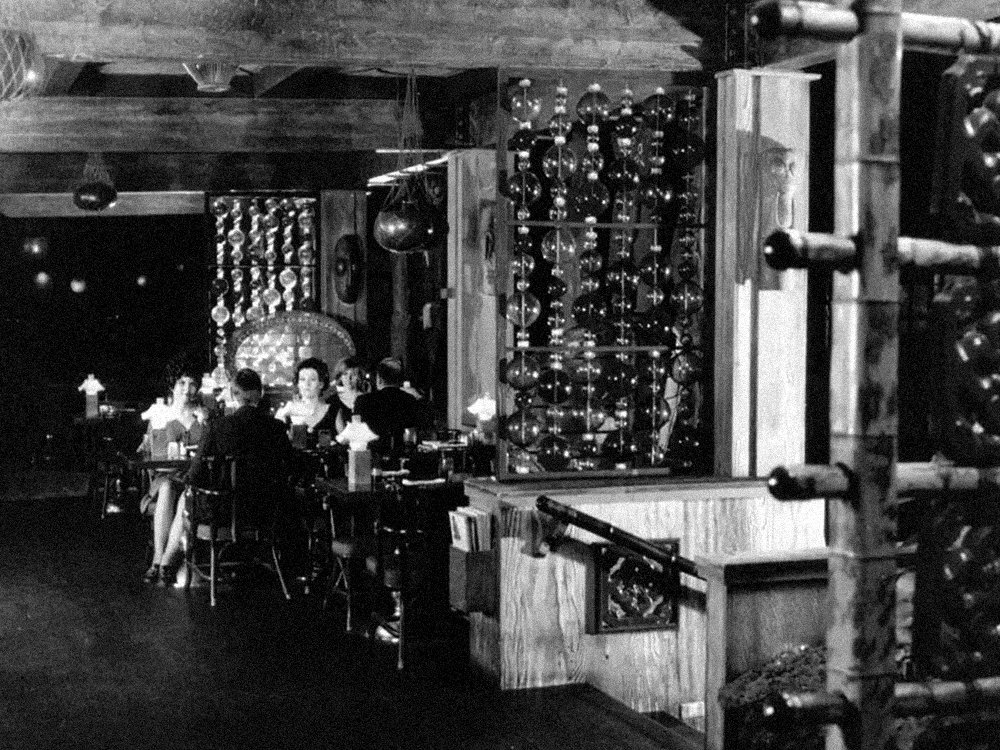
The Aku Aku featured native carvings and some tiki modernesque interior design work by Hawaiian artisan Edward “Mick” Brownlee (1929–2013), perhaps at the recommendation of Beach, with whom he had worked before. Along with strand upon strand of glass Japanese fishing floats arranged like abstract curtains.
1969 Aku Aku menu back page. Courtesy Los Angeles Public Library.
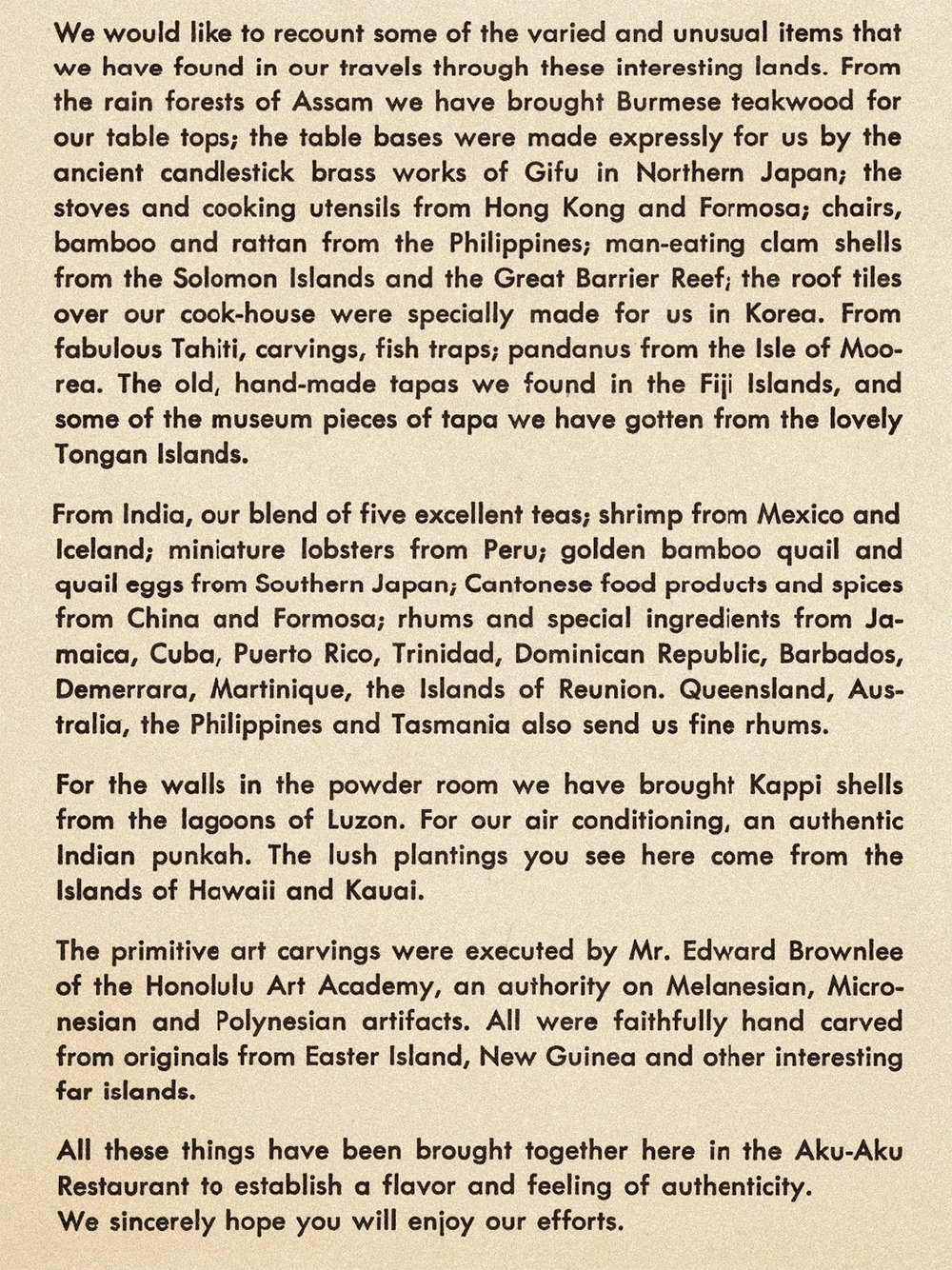
In a declaration common at the time, at the back of the Aku Aku’s menu the establishment boasted how authentic its food and decor was, specifically mentioning Brownlee “of the Honolulu Art Academy, an authority on Melanesian, Micronesian and Polynesian artifacts.” Brownlee, of course, was white, a native of Portland, Oregon.

Aku AKu menu cover from the early sixties.
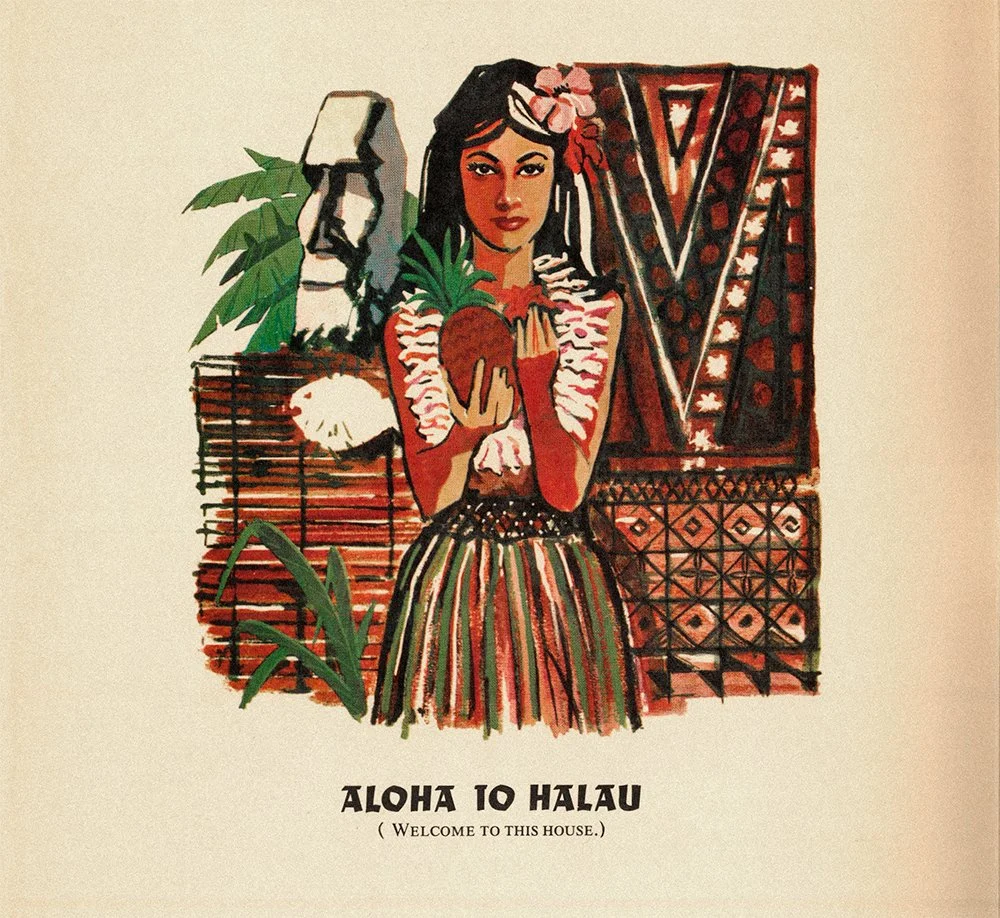
However “authentic” mid-century Polynesian Pop restaurants and bars claimed to be, the fact is that this design aesthetic was pointedly a middle class, suburban phenomenon completely detached from the actual native cultures of the South Seas. Even when dressed in foreign garb, as with the man in the turban on the menu cover above, the persons depicted were always caucasian.
1969 Aku Aku menu inside cover. Courtesy Los Angeles Public Library.
That is, except for native girls, which often had darker skin to emphasize and eroticize their supposed exotic looks.
Click for the clip on YouTube.
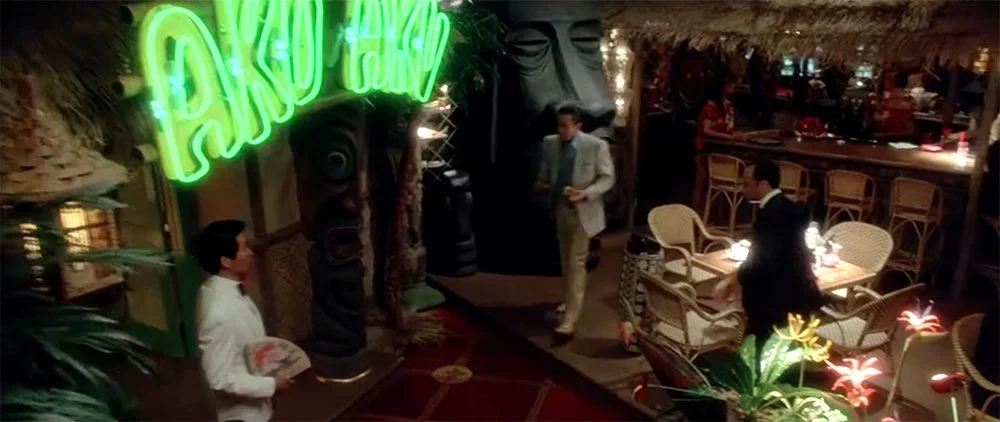
The establishment was iconic enough to be briefly re-created (quite inaccurately) inside The Riviera for a scene in the Martin Scorsese film Casino (1995).
Aku Aku interior entrance, circa 1974. Courtesy UNLV Special Collections and Archives.
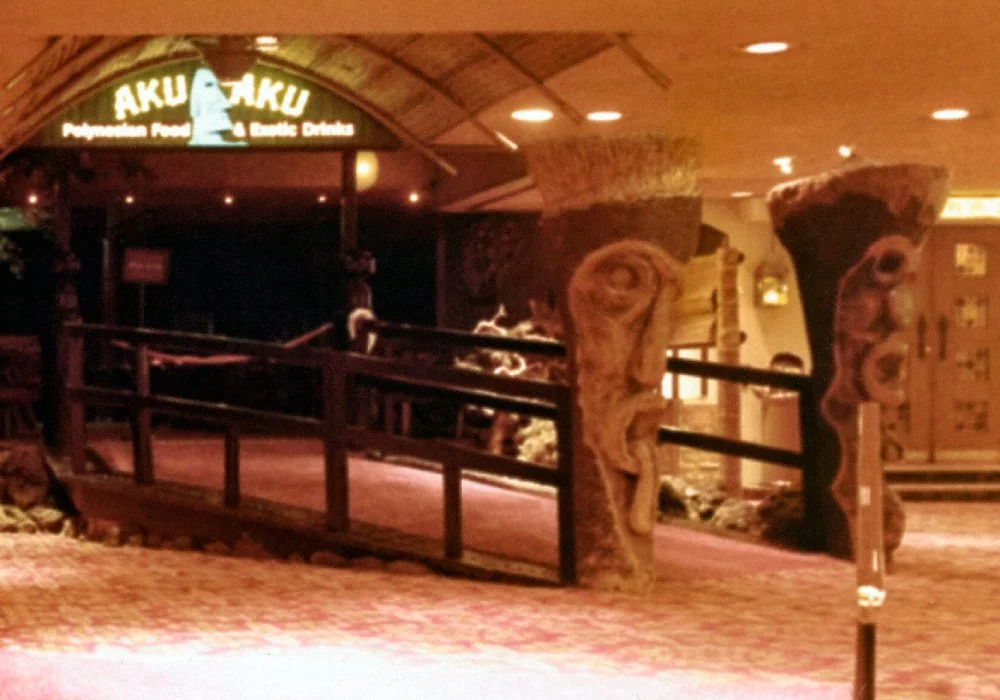
The actual interior entrance from the casino floor was a broad railed ramp flanked by two large carved tikis, neither of which were Moai. And although there was a backlit sign above the threshold featuring a single graphic of one, there was no green neon.
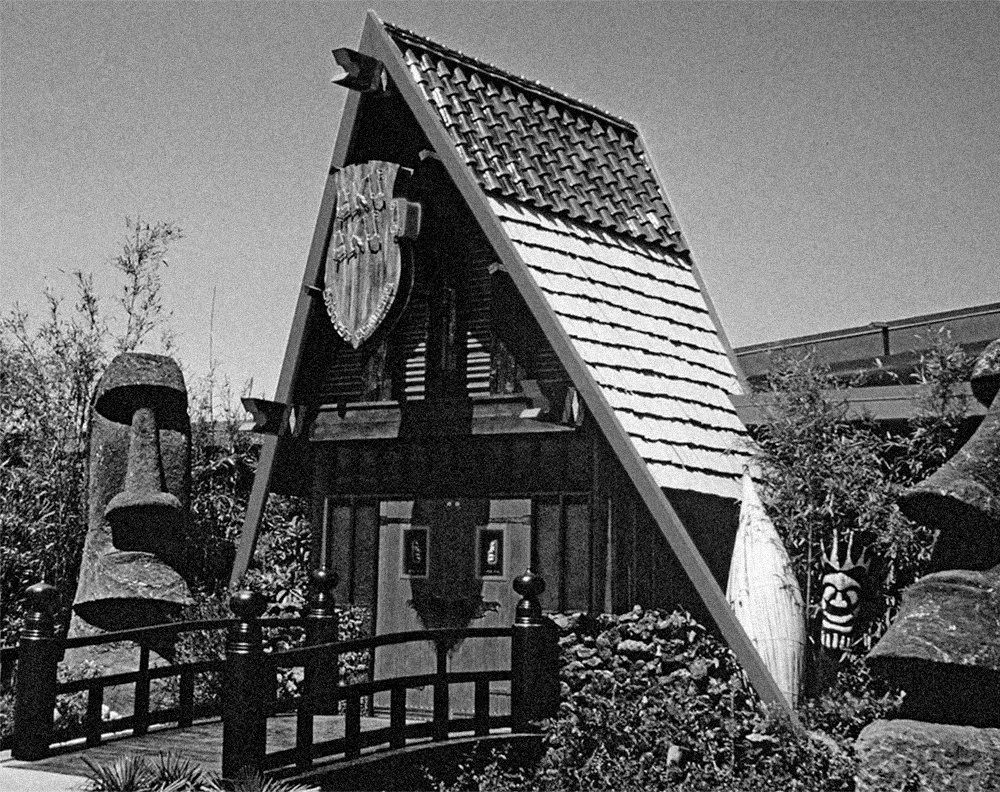
The exterior entry from the parking lot was even more outlandish, following the A-frame Polynesian supper club and bar design conventions of the time. Notice Eli Hedley’s large Moai carvings to the left and right.
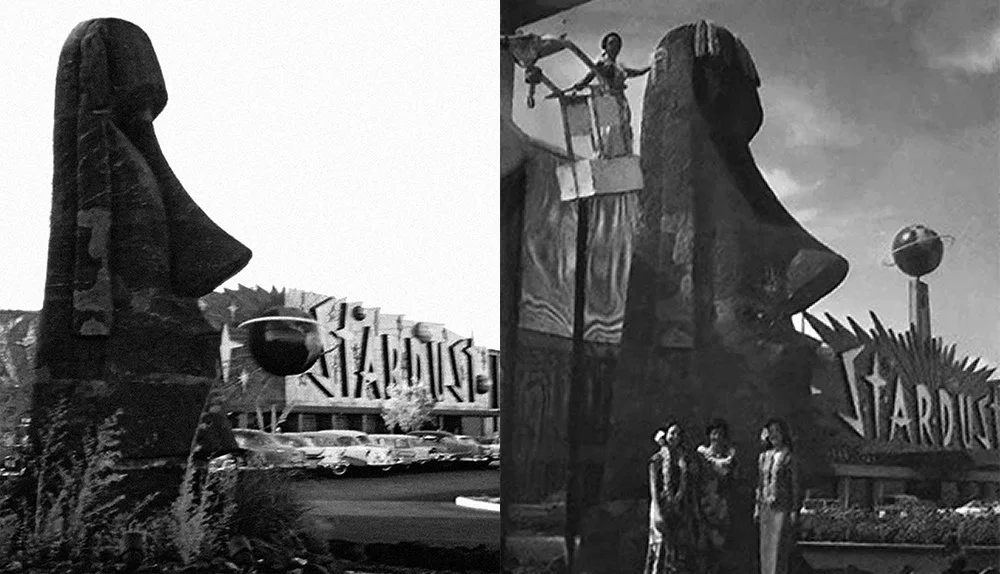
The one at the parking lot’s edge, however, was massive. More than a couple stories tall. The 1969 photograph on the right is from a 2000s Stardust room key and it really shows the scale of this Moai carving.
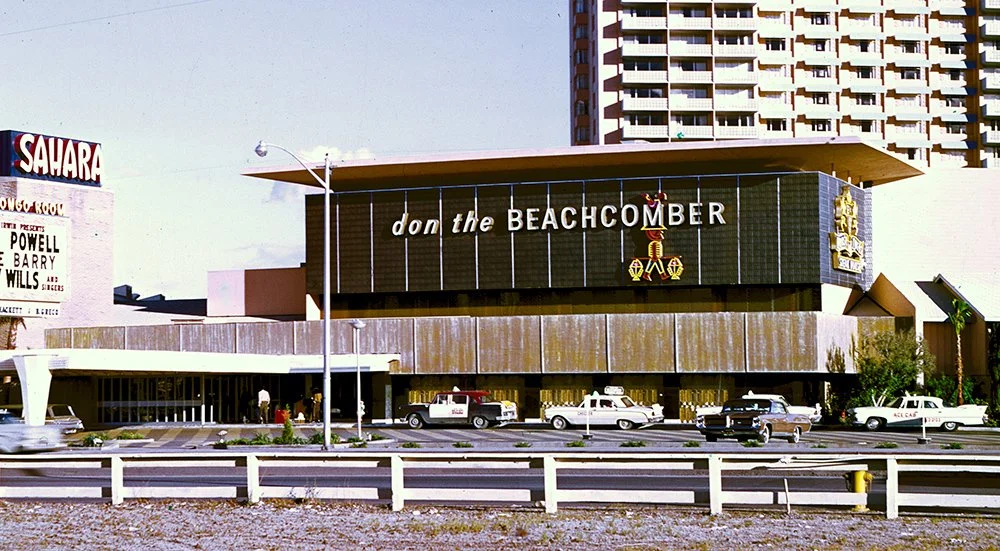
Don the Beachcomber, early sixties. Courtesy UNLV Special Collections and Archives.
The popularity of the Aku Aku set off a tiki boom of sorts. In 1962, Don Beach opened a franchise location at the Sahara Hotel and Casino.
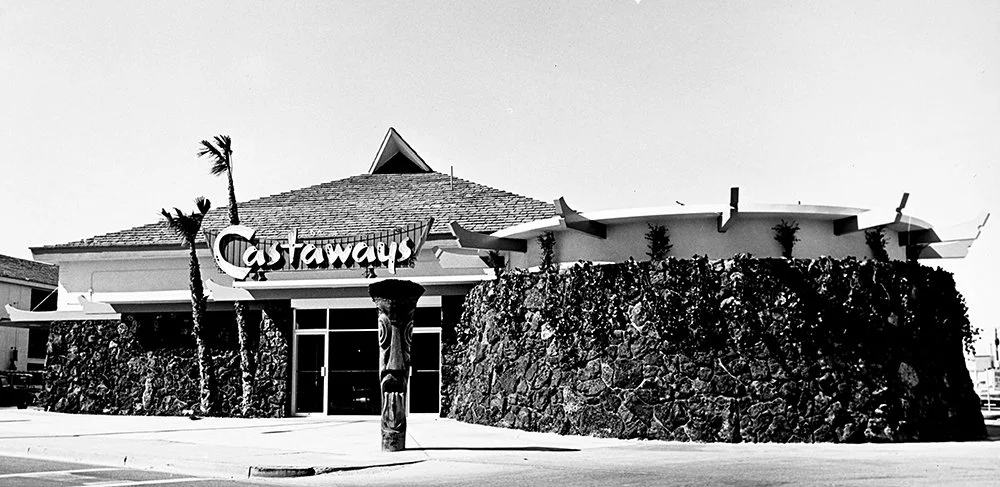
The Castaways, late sixties. Courtesy UNLV Special Collections and Archives.
Then a year later the Sans Souci Hotel, which opened in 1955, was re-themed as The Castaways, and remained the longest Polynesian Pop presence on The Strip until 1987 when it was demolished to make way for the Mirage.
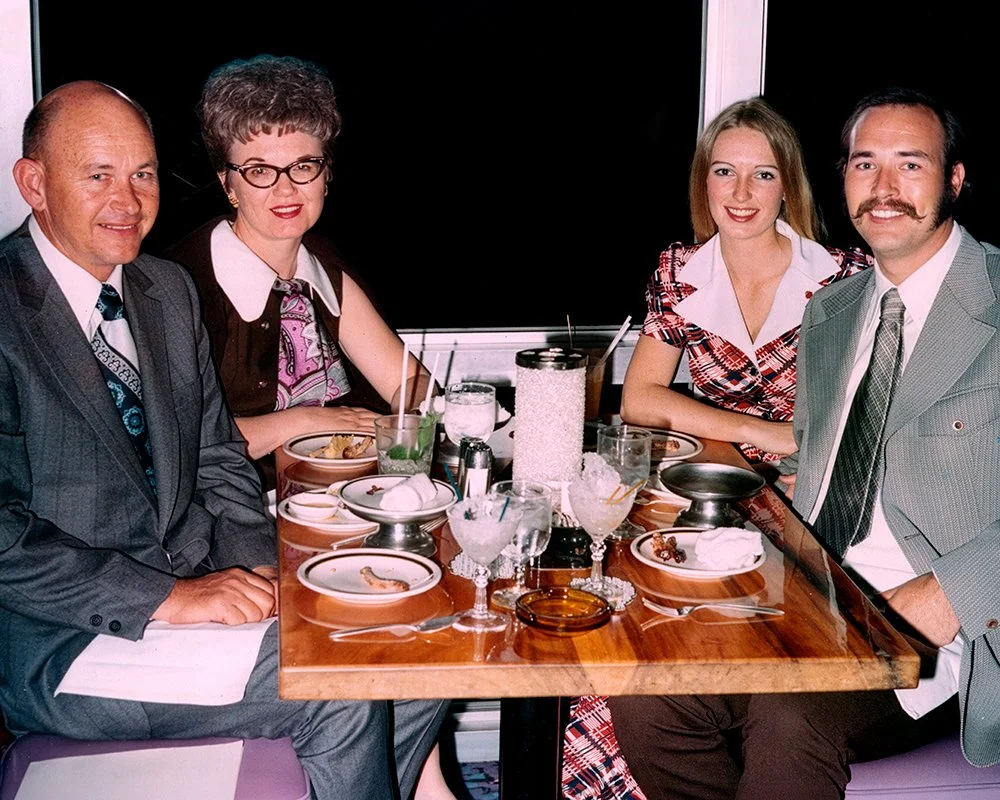
Family dinner at the Aku Aku, 1973.
For me the Aku Aku’s most historic and charming aspect is that while dating and pondering engagement, my mother and father dined there on May 4, 1973 with my father’s parents. You can see my grandmother’s drained mai tai glass along with a couple empty daiquiris and devoured baby Hawaiian barbecued spare ribs on the table in the foreground. In seven short years the bar and restaurant would be no more.
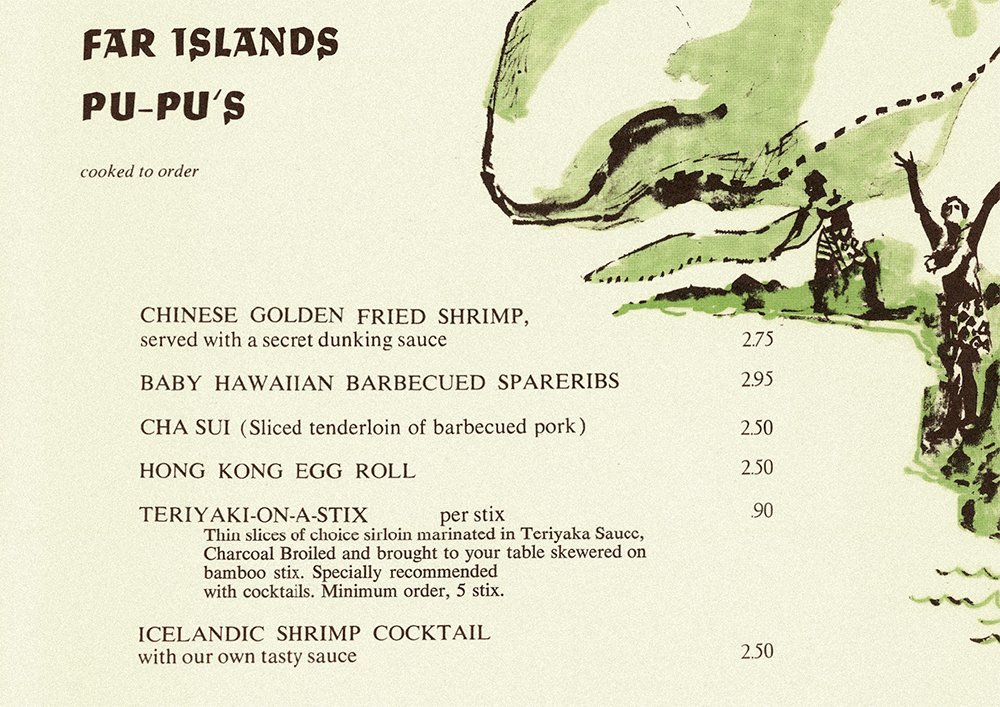
1969 Aku Aku menu. Courtesy Los Angeles Public Library.
Here you can see the appetizer or “pu-pu” list they ordered from. Pu pu is indeed a Hawaiian word which means hors dʻoeuvres. I can’t say what they cost when my parents dined there, but based on the 1969 price quoted about, those spareribs [sic] would set you back nearly $27 today.
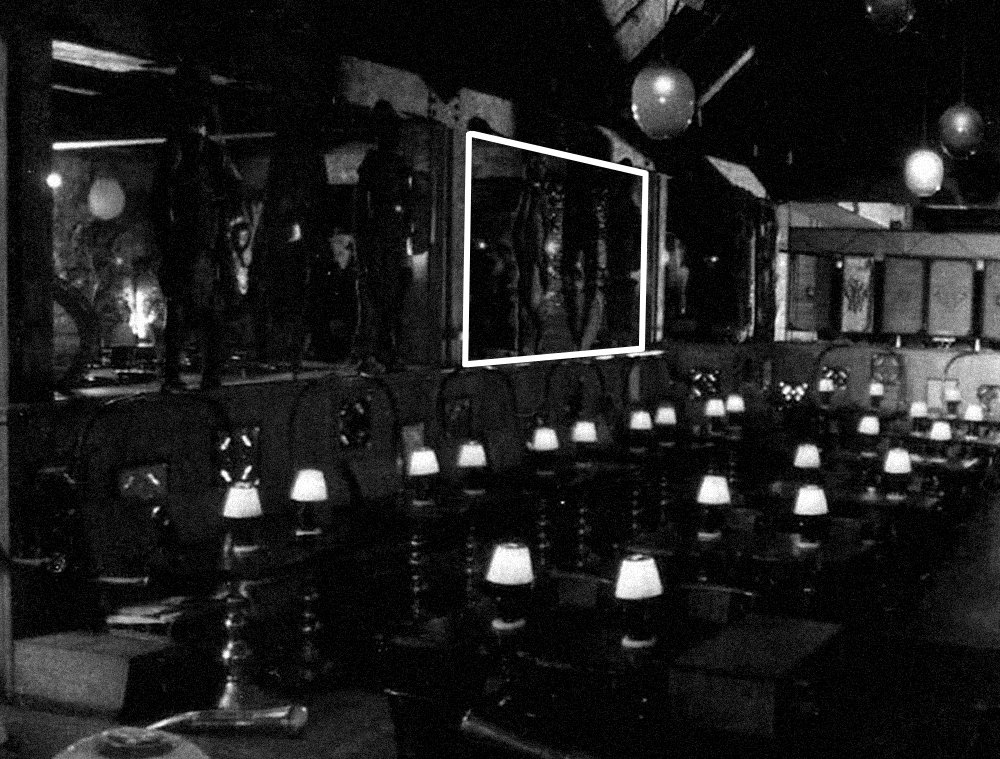
Where my parents likely sat (window portal highlighted with stroke).
I’ve tried to ascertain where my parents were sitting for their meal, but it appears to be behind one of these rectangular portals. All of the photographs I’ve been able to locate are from the 1960s, and I’m not sure how much remodeling had been done by 1973.

Attempts at a Revival
Tiki would not return to the Las Vegas Strip until 2001 with the opening of Taboo Cove at the Venetian Resort and Casino. The first new properly themed tiki bar to open in the United States since the early 1970s, Taboo Cove was designed and decorated by famed Polynesian Pop artist “Tiki Bosko” Hrnjak. Sadly it was shuttered by late 2004 and reopened de-tikified. Taboo Cove’s downfall was due to a poor location deep within a casino with a completely different theme, inadequate promotion, and blaring club music, which drove more authentic fans away.
The bar at Las Vegas Trader Vic’s, 2008.
Next was a Trader Vic’s location in the Miracle Mile shops at Planet Hollywood Resort & Casino. When I visited during the summer of 2008 it had not yet been opened a year. Apart from some large carvings and stylized graphics like this backlit mask behind the bar, the space was basically unthemed and was aimed at the vodka Red Bull crowd rather than actually Polynesian Pop aficionados. In 2009 Vic’s met the same fate as Taboo Cove, as much a victim of the economic downturn as its poor design.
Frankie's Tiki Room
Las Vegas is currently undergoing a tiki bar revival, however, that began with the opening of a new bar closer to downtown Las Vegas roughly six months before Trader Vic’s on the Strip folded, Frankie’s Tiki Room.
If the neon signage outside this white stucco stand-alone building looks like classic Vegas, it’s because it is. Liquid Vacation: 77 Refreshing Tropical Drinks from Frankie’s Tiki Room in Las Vegas (2013; reprinted 2024) notes that Frankie’s Bar and Cocktail Lounge had been around since the 1950s before falling into disrepair and being put up for sale. What inspired the owners of the punk rock Double Down Saloon, P Moss and his partner Chris Andrasfay, to buy it and turn it into a tiki bar was the loss of Taboo Cove. The redesigned Frankie’s opened on December 4, 2008.
The signage was kept and fitted with new graphics, keeping the original moniker in tribute to the good ol’ days of this local watering hole. From Liquid Vacation:
Some swear the bar was named after Sinatra. Not true. Some say it was named after the wife of the original owner. Maybe. But whatever the origin, and despite the fact that most tiki bars have Polynesian-sounding names, rebranding the new concept was never considered and the name Frankie’s was kept out of respect for a historic Las Vegas so many others are too quick to implode.
The marquee above routinely features humorous phrases, like FORGET ROSES BUY HER A MAI TAI or KNOCK BACK A VICIOUS VIRGIN / BE THE FIRST. My favorite is their Christmas greeting: GET A HEAD START ON HOLIDAY DRINKING.
The new lettering is typical of mid-century advertising and jumbles along the baseline as if dancing the conga.
The entrance is a mix of Polynesian Pop iconography and a playful illustration style that suggests tattoo art. The red door looks like a dive bar. This could easily be a biker hangout or a punk rock venue, and that’s part of Frankie’s charming-yet-sleazy exterior vibes. More downtown Las Vegas than the Strip. It feels like a local joint.
Printed along the backlit arch above are the words KAHI MALUHIA LOA I KA HONUA in the same funky typeface as the other FRANKIE’S and GAMBLING signs.
The phrase translates from Hawaiian as “The Most Peaceful Place in the World.”
Every traditional tiki establishment, like the Aku Aku, was typically guarded by statuary at the entrance, and Frankie’s is no different. These sit at either side of the front door. You can also see part of the vivid lowbrow mural to the right which wraps the entire ceiling of the arched entry.
Another more elaborate and unique carving sits off to one side by a bike rack.
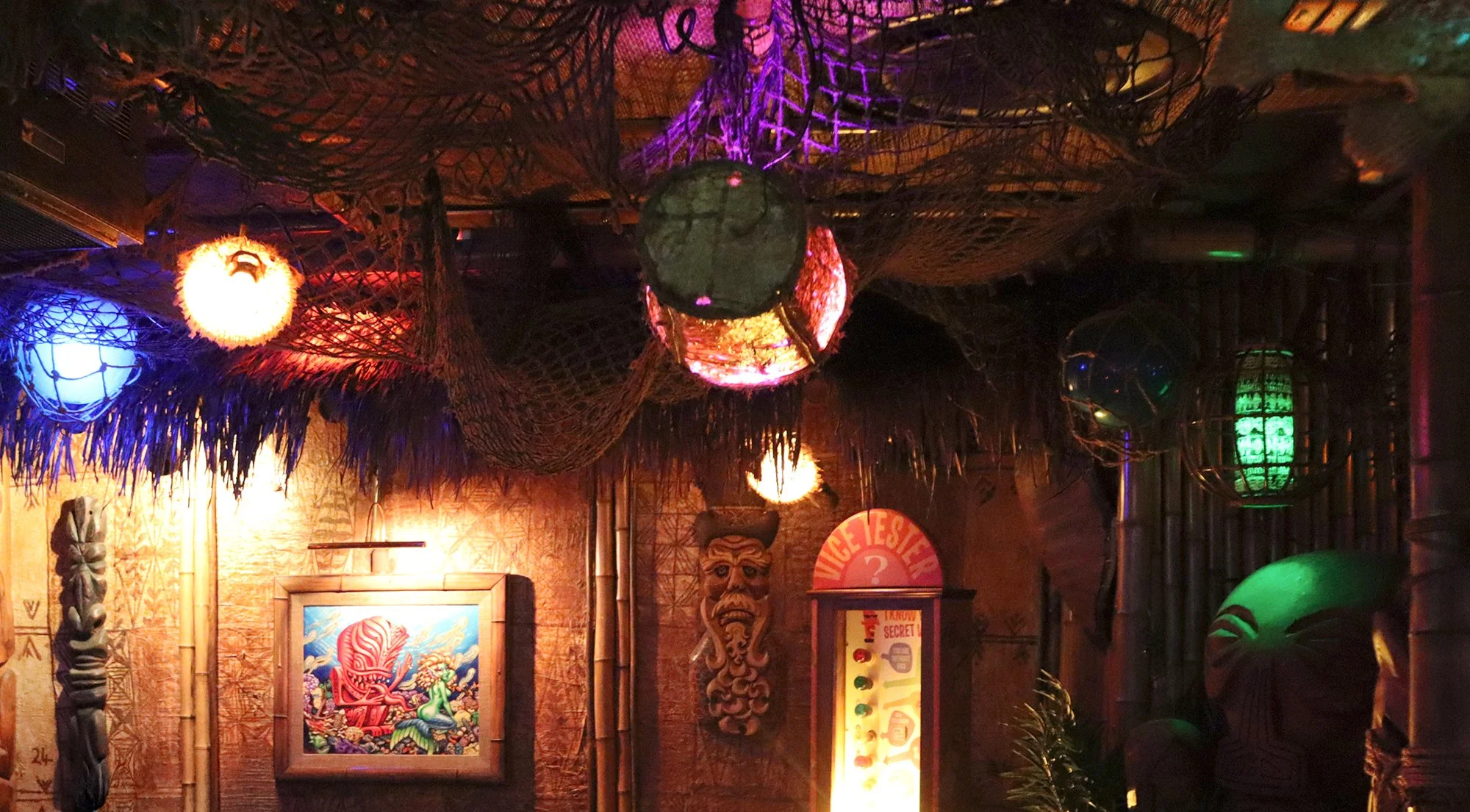
Walking in, you find a very, very dark bar. In fact it was difficult to take photos without a flash. But the decor is lush and recalls the classic tiki bars of the past.
Why all this talk of the Aku Aku before getting to Frankie’s? Well, because the interior was designed by none other than the grandson of Eli Hedley, noted carver and decorator “Bamboo Ben” Bassham. Ben has since gone on to design other tiki projects in Vegas, including one currently underway. Here’s a great 2015 interview with him.
Part of the charm of Frankie’s, which I’ve visited several times over the years, is that it splits the difference between themed immersion and what is clearly a typical Las Vegas cocktail lounge which can be found inside any casino.
To wit: Frankie’s is open twenty-four hours a day, seven days a week (a first for tiki). The bar is lined with video poker machines. You can smoke inside. So even though you can take your drink and wander over to one of the thatch-roofed seating areas, replete with Polynesian decor, it’s impossible to forget that you’re in Vegas. Frankie’s looks like it, sounds like it, and even smells like it, despite its tiki makeover.
Indeed there are moments where you can see the Frankie’s of the 1950s in the black ceiling poking through the thatch overhead.
However, they don’t call him Bamboo Ben for nothing. Every wall of Frankie’s is covered with it, along with many carvings and hand-crafted furniture, some of it provided by Tiki Bosko who had done the same for Taboo Cove.
Lowbrow artists were also commissioned to provide many paintings and tiki mug designs. This one above is typical of the lowbrow style and mixes pop icons like the Creature from the Black Lagoon (1954) with Bamboo Ben himself drinking alongside several characters that appear in Beetlejuice (1988).
Frankie’s successfully walks the line between the twenty-four hour video poker and indoor smoking Las Vegas is famous for, along with stirring in punk rock, biker bar, and lowbrow art with traditional tiki bar decor, drinks, and souvenir mugs. It’s a local favorite, has earned an entry in Atlas Obscura, and is a must-see for Polynesian Pop enthusiasts visiting town. I’ve been several times since it opened, and I’m sure I’ll be back.