
Polynesian Pop Coda: Come Fly with Me!
After my visit to Las Vegas, it appears that though I thought I was done with the theming of tiki, tiki was not yet done with me. On a flight down to Southern California this past summer, my connection was through San José Mineta International Airport. And to my surprise, right near my gate, was a Trader Vic’s location.
This is what is called a Trader Vic’s Outpost, and it’s been open since June 2021 here in Terminal B. The company describes them to potential operators as such:
[A] version of the original brand that still offers table service but with a smaller menu…adjusted to the location and may offer grab and go options as well.
So it’s kind of a satellite, mini-location for the brand. And while Trader Vic’s corporate describes the changes to the menu, it doesn’t mention the theming. Owing to its location in a busy airport terminal, the more immersive design of the classic Trader Vic’s restaurant location has been stripped away.
What remains is more of a branding exercise. Here the company logo and wordmark has been rendered on a piece of plexiglass mounted on a bamboo-lined host stand.
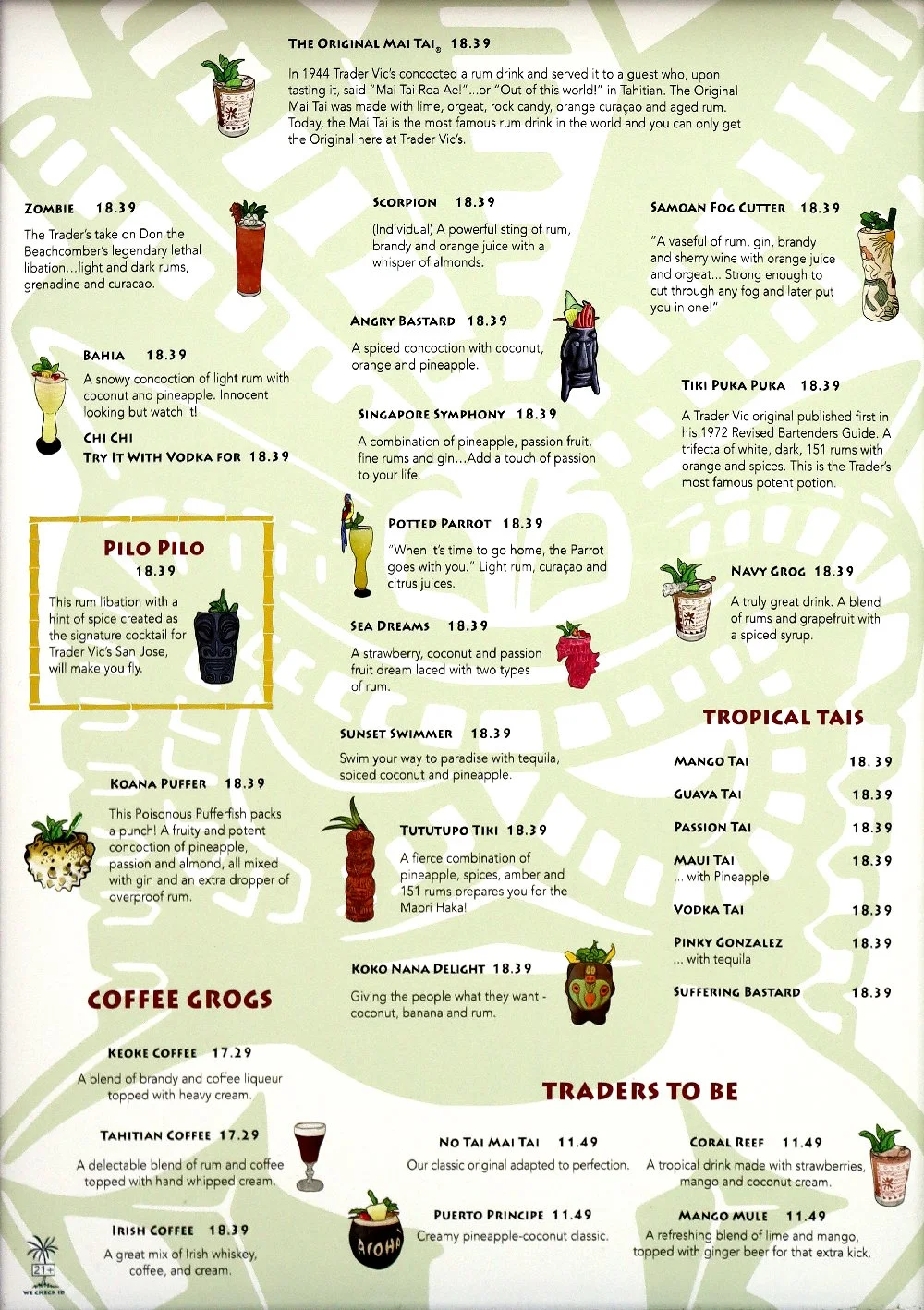
The company says that “the cocktail menu has about 25 drinks on it and is a mix of classic and new tiki drinks highlighting our signature glassware and mugs.” When I inquired as to why most of the drink prices end in thirty-nine cents, my bartender told me 1939 is a memorable date for Vic. Which is strange, because his original Hinky Dinks saloon in Oakland, California, opened in 1934 and according to the company reopened as Trader Vic’s in 1938. A year earlier. So someone goofed.
Interesting typographic note: The Trader Vic’s wordmark appears to be similar to Neuland (1923), a German wood typeface designed by Rudolf Koch (humorously, the lettering for the Trader Joe’s grocery chain is not too dissimilar). This menu, however, is typeset in Carol Twombly’s Lithos (1989). The substitution is common in theme parks (and zoos) all over the world because the two faces share some superficial traits.
As Dr. Benjamin George and I describe in our new book, Kingdoms of Artifice, we find themed spaces exist across three broad design categories. This Trader Vic’s Outpost is a blend of the first two—implicative and evocative theming. From our text:
The first category comprises spaces that only imply a sense of place. These are apt to be more muted architecturally… The next…on our spectrum evoke a sense of place but can be somewhat exaggerated or, alternately, simplified… While they communicate effectively through conspicuousness, evocative environments fall short of being plausible, and our disbelief is not suspended.
What that means is that certain key elements of what constitute “Trader Vic’s-ness” have been installed into what is a more neutral and almost modernist space. Chief among these are the statuary.
Trader Vic’s storage location, 2008.
The company maintains a stored cache of tike carvings from prior closed locations. I even visited this warehouse once in the Bay Area.
As you enter to the left is a bank of seating with some kind of native boat hanging overhead, no doubt from this same prop supply.
Here is where the implicative and the evocative collide. The backing wall behind is a modernist pattern of abstracted forms which contrast with the traditional painting and carving on the boat.
Same with this black steel framework, within which are strung traditional artifacts. As I’ve pointed out before, however, I do not use the appellation traditional to mean authentic, native, South Seas artifacts. I mean traditional mid-century tiki props.
This column is part of the airport’s superstructure, and the designers have made some attempt to hide it with these small carvings. They appear similar to those provided to chains like Trader Vic’s from the now-shuttered Oceanic Arts.
Oceanic Arts, 2010.
Since they closed in 2021, the same year this location debuted, it’s possible these pieces were indeed procured there. I have visited their warehouse twice and own a pair very similar to them. True to implicative theming, these are “notes” of the Trader Vic’s experience which have been sprinkled throughout as pieces of disjointed decor.
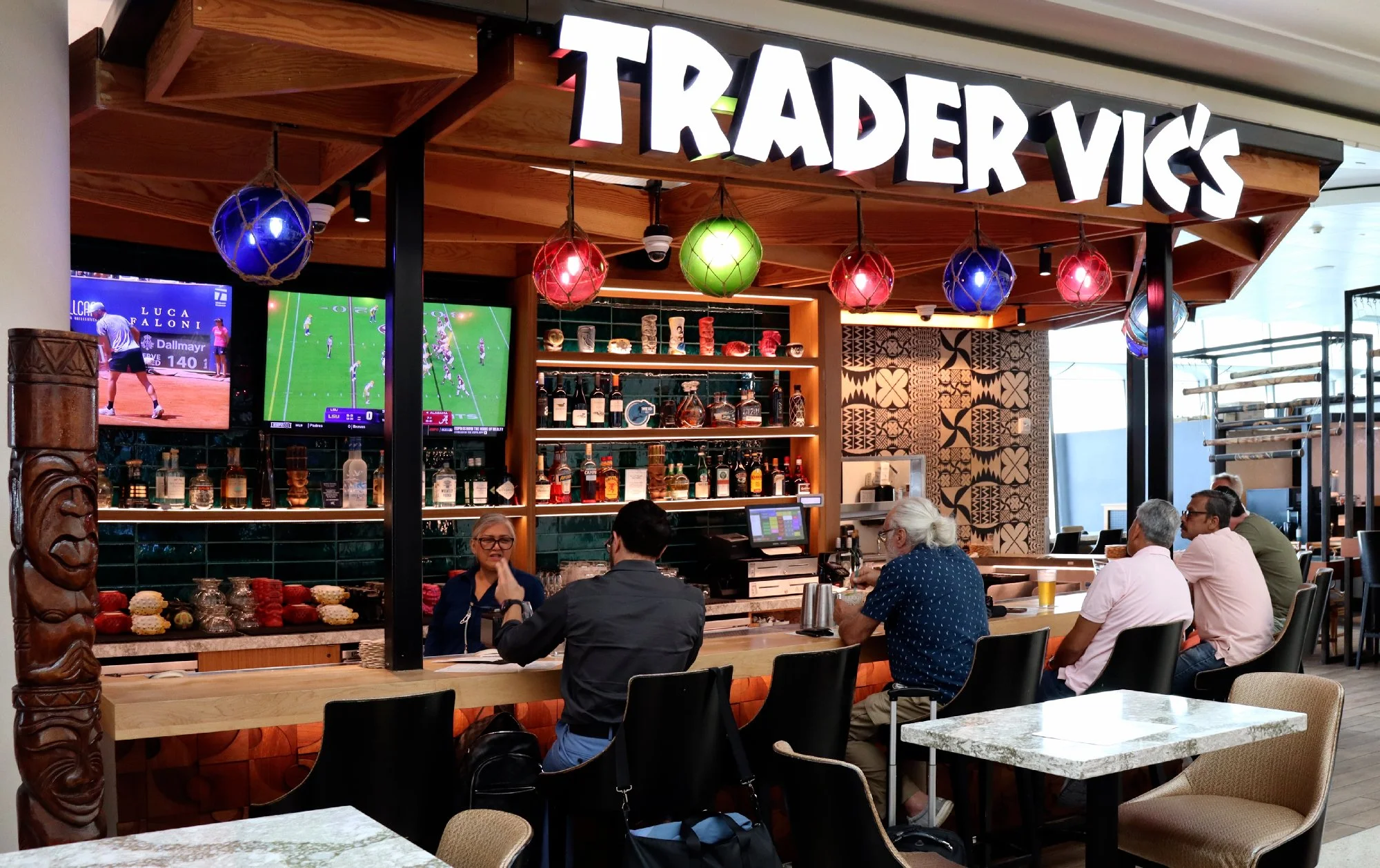
The bar area shifts the mood into something of an upscale resort. This feels like any of the mega hotels along the Kaʻanapali shores of the West Side of Maui.
It’s a classy and clean presentation. There is no lived-in quality or the aging present at older Trader Vic’s locations. Lived-in doesn’t mean shabby or dirty, mind you. Just those more immersive details that add a feeling of authenticity.
However nice the interior design here is, it still feels, well, designed. Placemaking that telegraphs that it was, in fact, constructed. Here you can see stacks of the custom tiki mugs Trader Vic’s is famous for, some of them supplied by Tiki Farm.
Another component of the Trader Vic’s brand “kit of parts” are these glass Japanese fishing floats common to all contemporary tiki bars. Here they contrast sharply with the modernist beams of the roof structure overhead. Same goes for the wallpaper pattern on the backing wall. It’s an implicative, evocative collage.
Each grouping of carvings reminds that we’re not truly immersed here.
These could have come from either the company’s own back storage or from Oceanic Arts. Based on their designs, I can tell none were newly commissioned by any of the revival carvers like Tiki Diablo (1971–2026) or Bamboo Ben.
Across the way from the bar the experience continues, announced by this tall fin which expresses the brand yet fits in with the rest of the airport’s concession signage.
Though the bar itself is also called an Outpost by the company, the title is only added to the brand here.
This is to distinguish it, because everything that is Trader Vic’s is here except the booze. Similar dishes for sit down, table service across the way are here offered as grab-and-go options for travelers on the move.
Here the implicative / evocative thematic blend is even further reduced to essentials. There is a single cluster of glass floats above the POC checkout.
These three carvings look old enough to have been sourced from the company’s storage and have been cut and installed in this modern counter shelf.
I found these light fixtures quite odd. They don’t fit with anything else, and could have been picked up at the old Pier 1 Imports or even Target.
Smartly, all the same souvenir tiki mugs are offered for sale, but here staged on a simple, off the shelf metal and glass display. Several interior design choices harmonize with the bar proper, however, like the wallpaper and jade green tile work.
This is the immersive themed experience of the mid-century tiki restaurant / bar chain distilled down to its most basic brand elements and applied like decor to what is otherwise a fairly modernist space. At an airport, I suppose it works. Trader Vic’s Outpost felt tiki enough for me, at least for a brief layover.
The San Jose location appears to be successful, and another Outpost at nearby Oakland Airport has been planned for years and is supposed to open soon.